Showing posts with label BUDDHADEB. Show all posts

Tuesday, July 15, 2014

Jyoti Basu’s Birth Centenary - Call to Defend Democracy


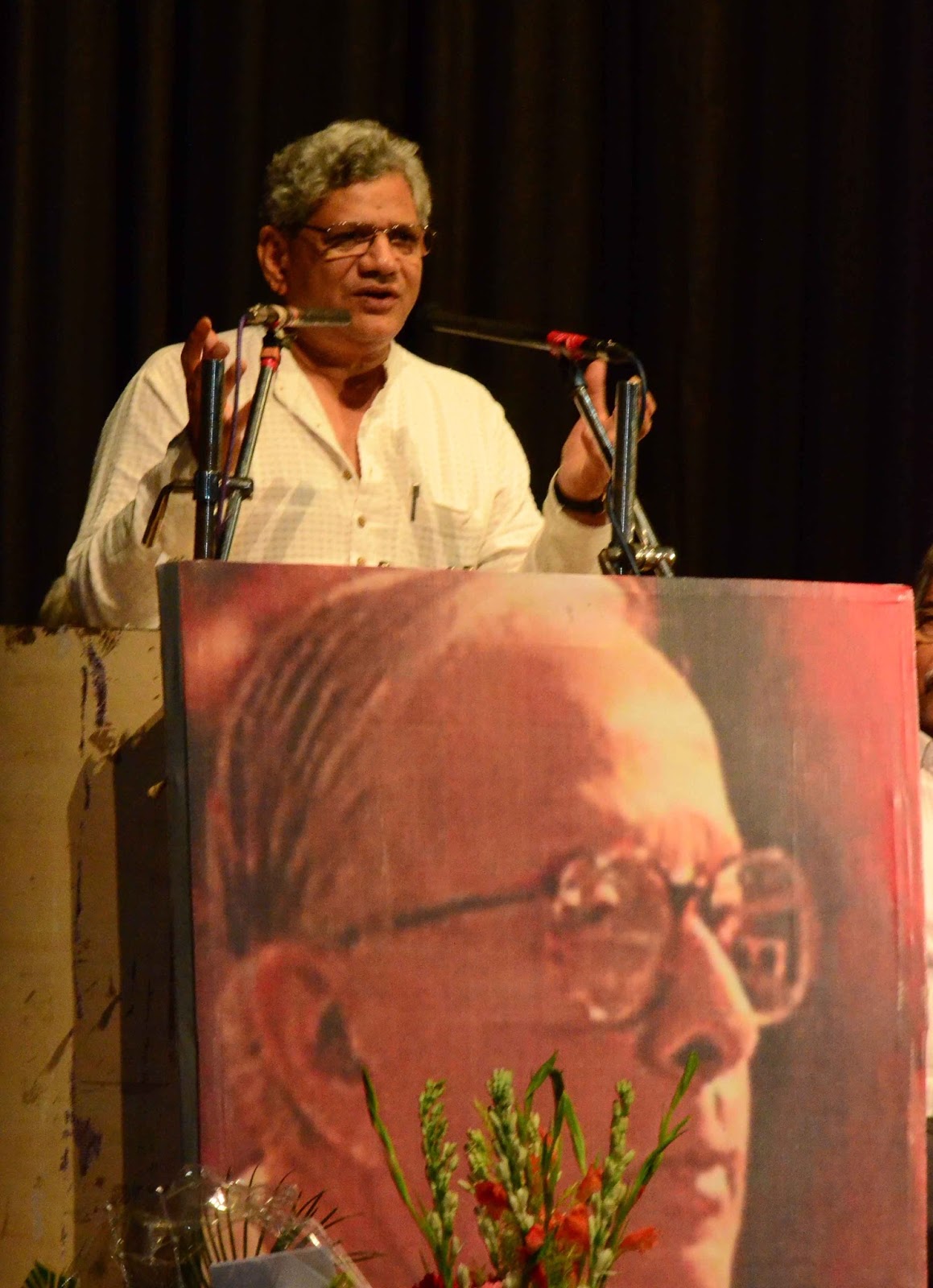
KOLKATA, 8th July, 2014: The birth centenary of Jyoti Basu - one of the most revered Communist leaders, was celebrated in West Bengal on 8thJuly with a variety of programmes including blood donation camps, seminars and cultural programmes. A central public meeting was organized by Jyoti Basu Birth Centenary Committee in Nazrul Mancha in Kolkata, attended by thousands and addressed by Left leaders and intellectuals. Jyoti Basu's photos were garlanded outside CPI(M) offices and those of its various mass organisations in the city and the districts
The public meeting began with a short documentary on Jyoti Basu. The meeting, presided by veteran Forward Block leader and Chairman of the centenary committee Ashok Ghosh, witnessed the presence of people from all sections of life and leaders of various left organizations.
Biman Basu, addressing the meeting highlighted the sacrifice of Jyoti Basu in his early life when he travelled to all parts of Bengal to develop the trade union. Biman Basu said, Jyoti Basu left personal happiness and luxurious life to serve the toiling people. Biman Basu also deliberated how Jyoti Basu fought ceaselessly to defend democracy. His thoughts and ideas on the struggle for democracy are important now as West Bengal and the country are facing an attack on democracy.
Elucidating the contribution of Jyoti Basu to parliamentary democracy, CPI(M) Polit Bureau member Buddhadeb Bhattacharjee said, Jyoti Basu had brought the struggle of peasants and working classes to the centre of politics in West Bengal.  “He brought the issues of peasants and the workers to the fore in parliamentary democracy. Its origins lay in the workers movement which was followed by strikes and protest in factories. These protests turned into a phenomenon which engulfed the entire industrial sector and workers were successful is ascertaining their rights,” Bhattachrarjee said. When the Left Front assumed office,  unlike any other Chief Minister, he made it clear that the government will have to stand for the rights of farmers and agricultural workers. “The fight for land went ahead with giving pattas (land rights) to the farmers and then identifying the rights of share croppers,” Bhattacharjee said.
Bhattacharjee reflected on how Mr. Basu ensured that the State remained insulated from the communal strife in 1984 after the murder of Indira Gandhi and 1992 after demolition of Babri Masjid. “He was secular to the core of his heart. He knew that Communist movement and secularism has to go hand in hand,” Bhattacharjee said.
 “Jyoti Babu has an unwavering faith in democracy.. Despite himself being arrested a number of times for false charges when the Left Front government came to power in 1977 all political prisoners across political lines were freed. It was like a general amnesty,” he said.
Referring to present times Bhattacharjee said that it is clear that the politics in the country has taken a “right turn” with the alliance of corporates and Rashtriya Swayamsevak Sangha (RSS) ruling the nation but added that it is imperative for the Left forces to take lessons from Jyoti Basu's life and put up a fight.
Noted economist Prabhat Patnaik outlined the features of contemporary Indian politics and said, neo liberal policies have created a situation where growth of industrial production has reached almost  negative, rate of inflation has risen to almost ten per cent. Corporate elite have chosen Modi to come out of their own crisis. On the other hand, the rapid growth of unemployment has contributed to growth of lumpen proletariat. The dangerous repercussions of the process is already evident in West Bengal where the attack on women and criminal activities are on rise. This situation can give rise to fascism. Only the Left can counter the threat of fascism through struggle on alternative policy trajectories.
Patnaik said, unlike P Sundarya, Jyoti Basu was born in an elite family. But he identified himself with the working people of the country. He was one of the most popular Communist leaders after Castro brothers. The crisis in Bengal was the backdrop in which the Left movement in Bengal developed and leaders like Jyoti Basu emerged. The Left could play its role as real initiator of Bengal renaissance.
Veteran CPI(M) leader Hasim Abdul Halim, CPI leader Manjukumar Majumdar, RSP leader Khisti Goswami, intellectual Azizul Haque emphasized the need of Left unity in this hour of difficult struggle.  

Friday, August 2, 2013

Tussauds-like wax tribute in Asansol


In Asansol’s Mahishila Colony, believe it or not, you can meet Jyoti Basu, Maradona, Mithun Chakraborty and Uttam Kumar in one room.

Of course, not alive and kicking, but as life-like wax models, all made by Sushanta Roy.

A better reference point to what Roy has done would be the wax statues in Madame Tussauds in London, where many a Bollywood star has found place.

On July 8, Sushanta celebrated Jyoti Basu’s birth centenary. He made offerings of food and flowers, as if to a god — which perhaps would have displeased the communist leader.

Roy, 50, has been making the wax sculptures for decades. He had been an admirer of Basu and had the privilege — if it can be termed so — to take his measurements at Indira Bhavan for the statue.

The Basu statue had been at Indira Bhavan from 2003 to 2011 — a gift on the then chief minister’s 89th birthday. But after the leader’s death, Roy was requested to take it back to Asansol. The statue, he said, was “melting for lack of care”.

Now in an air-conditioned room, Jyoti Basu has found a place beside Manna De, who plays a harmonium — the singer is in wax, not the harmonium, by the way.

Roy said he had been visiting Indira Bhavan since 2003 and would “congratulate Jyotibabu always on his birthdays”.

“The last time too I had gone to attend his birthday celebration organised by Pather Panchali,” Roy said.

Pather Panchali, an NGO run by Ramola Chakraborty, widow of former transport minister Subhash Chakraborty, had decided to set up a museum like the one of Madam Tussauds in London and had asked Roy, who trained in sculpture in Calcutta, to make 100 wax idols of well-known personalities — for the proposed museum in Salt Lake.

The proposal came to naught after Subhash Chakraborty’s death.

Roy, a former employee of the Indian Museum, completed 18 wax idols. “among them are Basu, Vidyasagar, Rabindranath Tagore, Swami Vivekananda, Kazi Nazrul, Kishore Kumar, Manna De, Uttam Kumar, Sourav Ganguly, Amitabh Bachchan, Maradona, Kapil Dev, M. Karunanidhi and Sachin Tendulkar,” he said.

He took care to include props to signify what each celebrity did. So, Sachin is seen holding aloft a bat and Sailen Manna, though old and bald, kicking a football. Mithun has a mike in his hand.

Amitabh Bachchan’s wax model was the first one that Roy made. It was commissioned by a fan club.

For some of the stars and politicians, Roy got a chance to take measurements. Madame Tussauds, too, takes measurements of celebrities which become much-photographed events leading to the opening of the statue at the museum.

For those whom Roy could not meet, “I had to make to with pictures,” he said.

Asked about the quantity of wax he need for each statue, Roy gave an example: “It took around 50kg of wax to make Subhash Chakraborty.”

Roy said the idea of making life-size wax models was prompted by a popular Nazrul song Momer putul (doll of wax).

Roy said he first makes the stuffing. “For that several kilos of cotton and paper are required. The wax is used after that.”

Also, all the statues are foldable to allow transporting convenience.

A finished sculpture could cost anywhere between Rs 50,000 and Rs 1.5 lakh. Some of the statues he made were sold to clubs of Bollywood fans.

Roy himself takes care of the statues, cleaning them every day in the air-conditioned room where they have to be kept. He runs a school near his house where he teaches children to sculpt wax idols.

After Basu’s death, the leader’s aide Joy Krishna Ghosh had called up Roy and requested him to take the statue back.

Roy got the statue back to his Asansol home in September 2011.

“I discussed the matter with Bimanbabu (Left Front chairman Biman Bose) and called up Sushanta Roy who had gifted the idol to our beloved Jyotibabu. I requested him to take it back for its better preservation,” Ghosh told Metro over phone.

On Basu’s birth anniversary on July 8, around 20 to 25 friends and neighbours of Roy gathered on the ground floor of his house to celebrate.

A two-pound cake was cut and lunch was served to the statue. “Basu’s favourites — pabda and tengra machher jhaal, flavoured rice, muger dal and payesh were served,” Roy said. There was also raj bhog, mihidana and sitabhog, all traditional sweets of Burdwan, to round up the feast.


What will happen to this collection after Roy? The wax sculptor thinks his grandchildren “Arnab and Sanjib, two toddlers who take great interest when I work”, would keep the collection in shape. 

SEE MORE:
Tussauds-like wax tribute in Asansol
Friday, July 12, 2013

Calls for Defending Democracy

Jyoti Basu’s Centenary Observance

Kolkata, 8th July:  THE birth centenary of Comrade Jyoti Basu began on July 8 with a call to defend the ideology he represented and tirelessly worked for.

The CPI(M) state committee organised a public meeting in Mahajati Sadan in Kolkata which was addressed by Prakash Karat, general secretary of the CPI(M) Biman Basu, state secretary and Buddhadeb Bhattacharjee, Polit Bureau member of the CPI(M). Leaders of the Left Front and other Left parties were present in the meeting. Thousands of people gathered to attend and had to listen to speakers standing outside on the road.

Speakers recalled the contributions of Jyoti Basu in the Left movement and in Indian politics.

The question of democracy, for which Jyoti Basu fought a long battle, came to the forefront.  Prakash Karat said, ‘’West Bengal blazed a new trail in democratic decentralisation under the leadership of Basu through panchayati raj which was institutionalised much before the 73rd and 74th amendments of the Constitution. The spirit of democracy and the great experiment of democratic decentralisation which developed and flourished under Basu is now under severe and vicious attack.  We are in the midst of a panchayat election that was sought to be scuttled and sabotaged by the powers that today are ruling West Bengal. The people, the Left Front and the democratic forces in the state will defend the legacy of Basu, who made the greatest contribution to the deepening of democracy in the country. They will fight back all these anti-democratic onslaughts that have been launched over the past two years in the state.”

“If you look back at the career of Basu, there is no other leader, irrespective of political party who has shown such a capacity, vision and determination to show that India remains and will be a democratic, federal and secular country,” Karat pointed out.

Describing Basu as a leader who knew how to work in parliamentary arena, Karat said he showed how a Communist Party should integrate work in the parliamentary forum with the movement outside.

“The birth centenary of Basu should not be just an occasion for us to commemorate and pay tribute to his glorious life,” he said. It would be more meaningful to utilise the year-long observance of the leader’s birth centenary to spread the ideas he stood for, Karat suggested.

 “Whether it is a question of defence of democracy, defence of secularism or defence of working people, all contributing to a social transformation that will make India a more equitable and just society, this is what Basu stood for,” Karat said.

Buddhadeb Bhattacharjee recalled the early life of Jyoti Basu and said that after returning from abroad, he decided that the path of India’s liberation lied in liberation of the working class. Basu joined in the working class movement and worked among the dock and railway workers. Throughout his life, the ideology of working class was his ideological commitment.

Bhattacharjee said, Jyoti Basu brought the question of workers and peasants to the centrestage even within the legislature. His speeches within state assembly in support of peasants’ and workers’ struggles were historic.

Bhattacharjee recalled how steadfastly Basu defended secularism and thwarted any attempts by communal forces when the Left Front government was in office. He said, ‘’We are faced with a new danger again. On the one hand, it is Congress with neoliberal policies and on the other hand, BJP with neoliberal policies plus Narendra Modi”.  He added, the doors of this state have been opened to the BJP and Modi. This is frightening.

Bhattacharjee pointed out that the panchayats, which empowered the poor are under serious threat. He called upon the people and the Left activists to work hard to keep the panchayats in the hands of the poor.

Biman Basu, presiding over the meeting, outlined the struggling life of Jyoti Basu and how he built working class organisations despite heavy odds. He also reflected upon Jyoti Basu’s contribution to the cause of federalism in the country. It was Jyoti Basu who raised the demand of more powers to the states and brought the agenda to the centrestage of Indian politics.

CPI(M)  also announced a year-long programme on the occasion of the birth centenary of Jyoti Basu. ''A wider programme cannot be chalked out initially as panchayat election is round the corner and also considering the fact that people will be busy in campaigns and polls,'' Biman Basu said. He said the Party would project the life and activities of Jyoti Basu through seminars, posters, documentaries and an effort for political education.

On July 8, red flags were hoisted in all parts of the state. In some districts, processions with Jyoti Basu’s portrait were organised. In many areas, blood donation camps were organised.

Respects were showered on Jyoti Basu in state assembly too. Leaders of different political parties paid rich tributes to Basu, particularly recalling his democratic way of functioning both as the opposition leader and chief minister and how he used to treat criticisms respectfully.

But the longest serving chief minister's centenary celebrations were surprisingly missing from the Writers' Buildings, where the present government has been observing birth anniversaries of luminaries throughout the year.

People's Democracy,

July 14, 2013