Showing posts with label BIRTH CENTENARY. Show all posts
Thursday, July 9, 2015
Saturday, June 28, 2014
Tripura Remembers Jyoti Basu
By Haripada Das
AGARTALA, 15th
June: THE
life and legacy of Comrade Jyoti Basu would always be the guiding light for the
party so as to come out of the hard days that the party is facing today, and to
carry forward the cause of the toiling masses that the party has been striving
for. This was the essence of the points made by speakers at an overflowing hall
meeting on the occasion of observance of Jyoti Basu’s birth centenary year at
Rabindra Shatabsrshiki Bhavan, Agartala on June 15.
Biman Bose and Manik Sarkar,
both Polit Bureau members of the CPI(M), addressed the hall meeting that was
presided over by the party’s state secretary Bijan Dhar. At the outset, floral
tribute and homage was paid at the image of the departed leader by the Polit Bureau
members, Central Committee members, state secretariat members and state
committee members present in the auditorium. Then followed the inaugural songs
performed by two cultural units, namely Gandiv and Krishti Kala Kendra.
Biman Bose, the CPI(M)’s
West Bengal state secretary and Polit Bureau member, presented a brief life
sketch of Comrade Jyoti Basu. Biman Bose narrated the atmosphere in Jyoti
Basu’s family which was very much friendly with the freedom fighters. This
deeply motivated young Jyoti to take to a jihad against British imperialism. A
young boy, whom his parents sent to London to build up a bright carrier, thus
got involved in India’s freedom struggle and came in touch with communist
leaders like R P Dutta in London. Basu ultimately came back to India to become
a party wholetimer and dedicated his whole life to the cause of the workers,
peasants and other toiling masses of the country. While a party wholetimer, he
adopted the Bengali language which he was never taught in academic institutions,
Biman Bose informed.
Bose also referred to Jyoti
Basu’s role in the Tebhaga movement, in raising up women’s defence squads, his
work among the railway workers, his guidance in the 1946 naval workers strike
and all-India employees’ strike, his role in combating communal riots in 1946,
his style of functioning underground when the party was banned in 1948, his
leadership in the movement against the Bang-Bihar merger plan, his contribution
in the relief work during the 1946 famine, his work as the party’s state
secretary since 1953, his exemplary work as a legislator in West Bengal
assembly which attracted people’s attention to the party’s work, and his
leadership in the United Front governments in 1967 and 1969.
Today it is not the first
time, Biman Bose said, that semi-fascist terror has been let loose against the
party in West Bengal. It was unleashed in 1972 and was combated and finally
defeated by the party. Jyoti Basu’s work in those days would remain the guiding
force in our endeavours to resist the ongoing all-out attack perpetrated by the
ruling Trinamool Congress on the communists in West Bengal today.
Referring to Comrade Jyoti
Basu’s performance as a chief minister with the so far longest tenure, Biman
Bose said Basu played a vanguard role in pressing for restructuring of the
centre-state relations and organised several conclaves with the opposition chief
ministers. This resulted in the setting up of Sarkaria commission which
recommended several positive measures to protect the rights of the states
against the centre’s whimsical attitude born out of political antagonism. Land
reforms ensuring distribution of excess land to the poor farmers and
establishment of barga rights in West Bengal were unequivocally appreciated by
one and all, and became a model for the country. Basu won nationwide respect
for his valiant stand during the anti-Sikh riot in Delhi in 1984 and Babri
demolition in 1992. His flexible attitude but ideological firmness in leading a
coalition government for 23 long years is a great lesson for all of us, Biman
Bose said.
Explaining the new situation
in the country, Manik Sarkar said a pro-Hindutva party has now come to power in
Delhi with the so far biggest share of seats in its life with a minority share
of votes. In fact the BJP subtly and craftily exploited the fallouts of the
Congress led UPA government’s misrule, which unleashed all-out attacks on the
lives and livelihood of the common people of our country over the last ten
years, coupled with huge scams involving trillions of rupees of the government
exchequer. The BJP also had the blessings of the corporate lobby which lavishly
poured out money for its poll campaign, Manik Sarkar said.
However, Sarkar said, there
is no reason to take this change as permanent or think that everything has been
lost. The fact is that 69 percent of the voters did not support the BJP. We
have to reach out to those sections of the people; we have to bring about a
change in their thinking and consciousness. There is no room for getting
frustrated. Comrade Jyoti Basu’s life and deeds teach us to go to the masses
again and again. We must also approach the vast masses who do not support us.
All the questions raised by them must be answered politely, with facts and
reason. They must be imparted class consciousness and drawn to the mass and
class organisations. The BJP has nothing good to render to the people. Rather
it is committed to compensating the big corporate houses which helped it come
to power. Our national unity and communal harmony are now under severe threat
from the RSS, the hardcore Hindutva force that has always been controlling the
BJP from behind the curtain. The CPI(M) alone cannot combat this danger. We
must rally all the like minded secular forces with us. If we successfully do
it, that would be the true homage to late Comrade Jyoti Basu, Manik Sarkar
asserted.
As for Tripura, Manik Sarkar
said, Jyoti Basu always paid special attention to our state, particularly
because of the extraordinary ethnic bonding of tribal and non-tribal masses in
the state; this is something uncommon in other states of the country. He would
cite this feature of the state while addressing the people in other states.
Expressing deep respect for
late Comrade Jyoti Basu in his opening speech, Bijan Dhar said Jyoti Basu was a
beloved leader of the people of Tripura. He started visiting Tripura since 1951
and came here many times till 2005. He came here in our victory as well as in
our hard days during 1988-93. He helped the state unit of our party with his
valuable suggestions and advices on many occasions. If we look back upon the
history of the Indian communist movement, we will see the communist party
moving forward while facing one crisis after another. Referring to the poor
performance of the party in Lok Sabha elections, emergence of the BJP as the
ruling party with an absolute majority in the parliament, and the semi-fascist
attacks let loose on the communists in West Bengal, a strong base of the party,
Dhar said we are now undergoing yet another crisis, but that is no reason to be
frustrated. The teachings of Comrade Jyoti Basu would show us the path to
overcome this crisis, he concluded.
The hall meeting ended with
the rendition of Internationale in chorus.
Peoples Democracy, 22nd
June, 2014
Labels:
2014,
BIMAN BASU,
BIRTH CENTENARY,
CPI(M),
MANIK SARKAR,
TRIPURA
Location:
Agartala, Tripura, India
Wednesday, November 27, 2013
Convention at COIMBATORE Remembers Comrade Jyoti Basu
By M
Girija
People's Democracy, November 24,
2013
COMMEMORATING
the birth centenary of Comrade Jyoti Basu, a great communist leader, the
Coimbatore district committee of the CPI(M) organised a convention on November
18, with the party’s general secretary, Prakash Karat, delivering the main
address. While celebrating the birth centenary of Comrade Jyoti Basu, Karat
said, we should draw lessons from the life and work of this great revolutionary.
India has seen many communist leaders who made great contributions and
sacrifices. But Comrade Jyoti Basu was one of the few leaders who stand tall
among them. He spent 70 years in the communist movement. He joined the
Communist Party in 1940 and passed into history in 2010. In these seven decades
of communist life, this great leader made very significant and pioneering
contributions. He returned from London as a barrister but began to work as a
trade union functionary among the railway workers in Bengal, becoming the
secretary of the railway workers’ union of Bengal. Though he was the chief
minister of West Bengal for about three decades, he had his association with
the trade union movement intact, and remained a leader of the CITU till the
end.
JYOTI
BASU IN LEGISLATURE
The
second major contribution of Comrade Basu was in legislative sphere. He got
elected to the Bengal Assembly in 1946, before independence, from the railway
workers’ constituency. From 1946 to 2010, except for a period of five years
following the rigged elections in West Bengal in 1972, he remained a member of
the West Bengal assembly, and showed how a communist should function in a
legislature. While he was a leader of the opposition, he led many struggles and
echoed the voices of struggling workers and others inside the assembly. In all
the major struggles, Comrade Basu made it a point to personally lead them, both
within and outside the legislature. Once he stayed inside the premises of the
assembly for three days lest the police should arrest him, in case he came out,
for leading the teachers’ struggle.
When
he became the chief minister of West Bengal in 1977, we saw how he carried
forward the land reforms there. After being a part of continuous struggles when
he was the deputy chief minister in United Front government earlier, he told
the peasants and Kisan Sabha members to go and occupy the lands the landlords
were holding illegally. Through this combination of outside struggles and
legislative action, Jyoti Basu showed the way as to how communists could
utilise such avenues. Between 1967 and 1969, when he was the home minister of
West Bengal, he told the police would not interfere with any strike conducted
by workers, nor it would be used to stop the peasants from occupying the surplus
lands in landlords’ illegal possession. His lasting legacy as the chief
minister of Left Front government is of the land reforms that were implemented
in Bengal, when 11 lakh acres of surplus land were taken over and distributed
among the landless farmers and 1.5 crore tenants got security of tenure by
registration.
Karat
further said: “History will also remember him as a leader who was most
consistent in the defence of secularism. Everyone knows that after the
assassination of Smt Indira Gandhi in 1984, Sikhs were killed in thousands in
the whole of North India. But Comrade Basu did not allow a single attack on the
Sikh community in Calcutta or West Bengal. Similarly, in the 1990s, when
communal forces began the movement for Ram temple in Ayodhya and communal riots
broke out all over the country after Advani’s rathyatra, Jyoti Basu said not a
single person would be allowed to be attacked in West Bengal, and that he was
ready to invite the army if necessary.” Comrade Basu was not only a communist
leader; he was a symbol of the Left, democratic and secular forces in our
country. That is why today, when we are observing his birth centenary, we must
pledge to continue to uphold the values, principles, politics and ideologies
which he represented, Karat added.
Speaking
on the current politics, Karat said today in our country we have a government
which is following policies that are causing great sufferings and distress to
the people of the country. In this context, he touched upon issues like the
excruciating and unabated price rise, especially in case of food items and
other essentials; favours being meted out to the big capitalists and foreign
multinationals; agrarian crisis and the farmers’ sufferings, rising
unemployment etc, with education, housing, healthcare etc all going beyond the
reach of the common man. Unless we are able to reverse these harmful
neo-liberal and anti-people policies being pursued by the UPA government, there
can be no real relief and no real development and progress for the people of our
country. “That is why the CPI(M) and other Left parties have put forth
alternative policies,” Karat added.
In
the context of the Lok Sabha elections which are nearing, Karat also attacked
the Bharatiya Janata Party which claims to be an alternative to the UPA and the
Congress, while Narendra Modi is going around the country posing as if he is
already the prime minister elect of the country. But, Karat said, the BJP is
not a whit different from the Congress in terms of policies, and that we have
seen in practice, e.g. in the BJP’s support to the UPA government on the issue
of banking laws, privatisation of the pension funds etc.
Karat
further said if the BJP today, under the leadership of Narendra Modi, is
claiming to be better than the Congress, it is better in only one way ---
Narendra Modi is a more ardent and vigorous supporter of the big business
houses of our country. They talk about the Gujarat model of development for the
country. But what does the Gujarat model mean?
Under Modi, all the big business houses – from Ambanis to the Tatas,
Essars, Adanis –have been given huge concessions, free land, free electricity,
tax exemptions and other concessions so that they could make super profits.
This is the model of development which Narendra Modi wants to implement in the
whole country. Another aspect of the Gujarat model, which Modi and BJP do not
talk about, is how they organised attacks on and carried out the most heinous
pogrom against the Muslim minorities in Gujarat in 2002, under the auspices of the
Gujarat government.
The
CPI(M) leader also pointed out that even though the Congress and the BJP both
say they would lead the government after the Lok Sabha elections, they have,
taken together, not been able to get 50 percent of the votes in the last two
Lok Sabha elections. As for the non-Congress, non-BJP parties, they command
substantial support among the people and are successfully running many state
governments. So we are confident that in the coming days the people will reject
the UPA for its wrong policies and massive corruption and also the BJP for its
equally corrupt practices in the states it is ruling and its communal politics.
What is required is people’s mobilisation and struggle to demand alternative
policies that are different from those of the Congress and the BJP. In this
context, Karat also referred to the recent Delhi convention of 14 non-Congress
secular parties and its significance.
Referring
again to Comrade Jyoti Basu as an architect of land reforms in West Bengal,
Karat said more and more people are losing their land today. According to the
latest census figures of 2011, in the last ten years 35 percent of peasants
have become agricultural workers, which means 35 percent more people have lost
their land. That is why we say we have to still implement the land reforms and
distribute lakhs of hectares of surplus land among the landless people and give
housesites to lakhs of families. These are some of the alternative policies
required in the country today.
Talking
of the contours of a policy alternative, Karat included in it a minimum wage of
Rs 10,000 per month for unskilled workers, more government spending on
education and health, and taxing the rich for adequate resource mobilisation,
among other things. It is through struggles on these issues that a political
alternative to the Congress and the BJP would emerge, he added.
Concluding,
Prakash Karat expressed confidence that the efforts of the CPI(M) and other
Left parties would find a reflection in the coming Lok Sabha elections, and the
non-Congress, non-BJP forces would get substantial electoral support.
CPI(M)’s
Tamilnadu state secretary G Ramakrishnan and its Central Committee member A
Soundararajan, MLA, also addressed the convention. Both of them recalled the
memories of Comrade Jyoti Basu.
The
convention was presided over by U K Vellingiri and inaugurated by V Ramamurthi,
secretary of the CPI(M)’s Coimbatore district committee. S Krishnamurthi
welcomed the participants and Kesavamani proposed the vote of thanks.
Earlier,
a sum of Rs 10,08,500 was handed over to Prakash Karat by the Coimbatore
district committee as the second instalment of the election fund donated by the
people.
Labels:
2013,
BIRTH CENTENARY,
CPI(M),
PRAKASH KARAT
Location:
Coimbatore, Tamil Nadu, India
Thursday, September 19, 2013
Amartya Sen on Jyoti Basu centenary panel advisory board
KOLKATA: Nobel laureate Amartya Sen will be a member of the advisory board of the Jyoti Basu Birth Centenary Celebration Committee, said Rabin Deb, CPI(M) State Committee member here on Monday.
He was speaking at a discussion to finalise the names of the members of the committee.
Other eminent members of the committee include the former Chief Minister, Buddhadeb Bhattacharjee; the former Lok Sabha Speaker, Somnath Chatterjee; film director Mrinal Sen; poet Sankha Ghosh; and former Indian captain Sourav Ganguly. State CPI(M) Secretary Biman Bose will be its general secretary.
Pointing out that Jyoti Basu had created an impression at the personal level too, with the various people he interacted and worked with, Mr. Bose said the aim was to highlight “milestones” of the political career of the Marxist leader.
Mr. Chatterjee said: “I believe the committee will be able to bring into focus Basu’s work for the public and his faith in the people.”
Samaresh Banerjee, retired judge of the Calcutta High Court, recalling the administrative capabilities of Basu, said “He was not only a politician, but a real statesman.”
Saturday, August 17, 2013
Friday, August 2, 2013
Jyoti Basu Birth Centenary Observances Begin in Maharashtra
By Mahendra Singh
MUMBAI: ON July 8, 2013, the Mumbai
committees of the Communist Party of India (Marxist) and the Centre of Indian
Trade Unions (CITU) flagged off the Jyoti Basu birth centenary celebrations
with a joint public commemorative meeting in Venmali Hall in Dadar (West). The
hall was fully packed on the occasion. A photo of late Comrade Jyoti Basu
adorned the dais, along with a photo of late Comrade Ahilyatai Rangnekar, a
beloved party leader, whose birthday also falls on July 8. Mahendra Singh, the
CPI (M)’s Mumbai committee secretary presided. Seated on the dais were CPI (M)
Central Committee member and state secretary Dr Ashok Dhawale, Central
Committee member K L Bajaj, and all-India vice president of the CITU, CPI(M)
state committee member and the CITU’s all-India working committee member Sayeed
Ahmed, CPI(M) state secretariat member Professor Krishna Theckedath, state
committee members Dr S K Rege and Shailendra Kamble, and CITU Mumbai secretary
Dr Vivek Monterio. Dr Ashok Dhawale and K L Bajaj garlanded the photo of Jyoti
Basu and Ahilyatai Rangnekar respectively. While Dr Dhawale, K L Bajaj, Sayeed
Ahmed and Vivek Monterio highlighted Comrade Jyoti Basu’s outstanding
contribution, they also dwelt on the purpose of the meeting. Shailendra Kamble
conducted the proceedings.
The CPI (M) state committee’s organ, Jeevan
Marg (Marathi weekly), had published a special issue
to commemorate the Jyoti Birth centenary. K L Bajaj released the new issue at
the meeting.
In his introductory remarks, Sayeed Ahmed praised the invaluable
contribution of Jyoti Basu to the Indian working class movement and to the work
done by the Left Front government of West Bengal in the interest of
the toiling masses and common people including the workers, peasants and
agricultural workers, under his chief ministerial tenure. K L Bajaj dwelt on
the important role played by Jyoti Basu in founding and building the CITU. He
also highlighted the stellar contribution of Jyoti Basu in the Indian working
class and communist movements. Addressing the audience, Dr Vivek Monterio
pointed to the 50 years long membership of Jyoti Basu of the West
Bengal legislative assembly; he said Comrade Basu’s ideal style of
functioning in it as a communist is a guide for communists for all the time to
come. Dr Ashoke Dhawale, in his detailed speech, threw light on various aspects
of the outstanding personality of Comrade Jyoti Basu and his invaluable
contribution in the Indian communist movement and in building of the CPI(M). He
referred to the police lathi blows faced by Jyoti Basu as a school student
while participating in a public meeting addressed by Netaji Subhash Chandra;
his participation in the activities of India League and London Majlis while
studying in London; his stellar performance as a legislator, opposition leader,
deputy chief minister, home minister and chief minister; the pro-people
activities of the first Left led government of West Bengal under his stewardship;
his immense contribution in strengthening the Left politics in India and
raising the issue of restructuring of centre-state relations; his unique party
loyalty and adherence to party discipline; his firm belief in Marxism-Leninism;
his daily visit to the party’s state committee office even when he was
discharging onerous responsibilities as the chief minister; his unshakeable
faith in the toiling masses; and his exhortation to the party members to
increasingly strengthen contacts with the masses. In his speech Mahendra Singh
urged upon the audience to plan various programmes during the year long
observance to take the message of Comrade Jyoti Basu to the wider masses and to
take pledge to advance the cause for which Jyoti Basu worked for almost seven
decades.
All the speakers also paid tributes to Comrade Ahilyatai Rangnekar.
The meeting ended with slogans like “Jyoti
Basu Lal Salaam,” “Comrade Jyoti Basu Amar Rahe” and “Long Live Marxism-Leninism!”
Labels:
2013,
BIRTH CENTENARY,
MUMBAI
Location:
Mumbai, Maharashtra, India
Friday, July 12, 2013
Social media users pledges allegiance to Jyoti Basu's politics
IANS; Updated:
Tuesday, July 9, 2013, 12:55 [IST]
Kolkata, July 9:
Hundreds of social media loyalists of Jyoti Basu renewed their allegiance to
the late Marxist patriarch's ideologies Monday - the launch of the former West
Bengal chief minister's centenary celebrations.
Legions of loyalists paid
tribute to their celebrated "Comrade" through comments and poems on
the social networking site Facebook.
Pledging support to Basu's
philosophy, many dubbed the "leader of masses" as an inspiration.
A post said: "Aj amader
priyo jononeta Comrade Jyoti Basu er Jonmo Sotoborsho....Tumi aj o acho amader
majhe Onuprerona hoye...Tomar dekhano poth e amra chilam, achi & thakbo ei
sopoth nilam...(Today is our beloved people's leader's birth centenary...you
live among us an inspiration..we are and always will be on the path that you
have shown us..)".
Some vowed to undo the
"deviation from the ideologies of Comrade".
"Comrade Jyoti Basu'r
jonmosotobarshiki upolokkhe 1ti bishoye protiggabodho hoya khub joruri,,seta
holo adorso-goto jetuku bicchuti hoyeche, setak sudre naoya..setai hobe COMRADE
sothik sroddha janano (On the centenary celebrations of Comrade Jyoti Basu we
have to pledge our return to the ideologies of Basu.. from which we have
deviated..that will be the true way to to pay respect to him)".
The Communist Party of
India-Marxist has lined up year-long programmes throughout the state,
highlighting his life and philosophy to mark the centenary celebrations.
Born July 8, 1914, Basu joined
the Communist Party of India in 1940 and began his work in the railway trade
union movement. In 1946, he was elected to the Bengal legislative assembly from
the Railway constituency.
He played a key role in the
development of the communist party in India and was the secretary of the CPI's
provincial committee from 1954 to 1960. He became a member of its central
committee of in 1951. When the CPI-M was formed, he became one of the founder
politburo and central committee members.
Labels:
2013,
BIRTH CENTENARY,
SOCIAL MEDIA
Location:
Kolkata, West Bengal, India
Calls for Defending Democracy
Jyoti Basu’s Centenary Observance
Kolkata, 8th July: THE birth centenary of Comrade Jyoti Basu
began on July 8 with a call to defend the ideology he represented and
tirelessly worked for.
The CPI(M) state committee organised a public
meeting in Mahajati Sadan in Kolkata which was addressed by Prakash Karat,
general secretary of the CPI(M) Biman Basu, state secretary and Buddhadeb
Bhattacharjee, Polit Bureau member of the CPI(M). Leaders of the Left Front and
other Left parties were present in the meeting. Thousands of people gathered to
attend and had to listen to speakers standing outside on the road.
Speakers recalled the contributions of Jyoti
Basu in the Left movement and in Indian politics.
The question of democracy, for which Jyoti
Basu fought a long battle, came to the forefront. Prakash Karat said, ‘’West Bengal blazed a
new trail in democratic decentralisation under the leadership of Basu through
panchayati raj which was institutionalised much before the 73rd and 74th
amendments of the Constitution. The spirit of democracy and the great
experiment of democratic decentralisation which developed and flourished under
Basu is now under severe and vicious attack.
We are in the midst of a panchayat election that was sought to be
scuttled and sabotaged by the powers that today are ruling West Bengal. The
people, the Left Front and the democratic forces in the state will defend the
legacy of Basu, who made the greatest contribution to the deepening of
democracy in the country. They will fight back all these anti-democratic
onslaughts that have been launched over the past two years in the state.”
“If you look back at the career of Basu,
there is no other leader, irrespective of political party who has shown such a
capacity, vision and determination to show that India remains and will be a
democratic, federal and secular country,” Karat pointed out.
Describing Basu as a leader who knew how to
work in parliamentary arena, Karat said he showed how a Communist Party should
integrate work in the parliamentary forum with the movement outside.
“The birth centenary of Basu should not be
just an occasion for us to commemorate and pay tribute to his glorious life,”
he said. It would be more meaningful to utilise the year-long observance of the
leader’s birth centenary to spread the ideas he stood for, Karat suggested.
“Whether it is a question of defence of
democracy, defence of secularism or defence of working people, all contributing
to a social transformation that will make India a more equitable and just
society, this is what Basu stood for,” Karat said.
Buddhadeb Bhattacharjee recalled the early
life of Jyoti Basu and said that after returning from abroad, he decided that
the path of India’s liberation lied in liberation of the working class. Basu
joined in the working class movement and worked among the dock and railway
workers. Throughout his life, the ideology of working class was his ideological
commitment.
Bhattacharjee said, Jyoti Basu brought the
question of workers and peasants to the centrestage even within the
legislature. His speeches within state assembly in support of peasants’ and
workers’ struggles were historic.
Bhattacharjee recalled how steadfastly Basu
defended secularism and thwarted any attempts by communal forces when the Left
Front government was in office. He said, ‘’We are faced with a new danger
again. On the one hand, it is Congress with neoliberal policies and on the
other hand, BJP with neoliberal policies plus Narendra Modi”. He added, the doors of this state have been
opened to the BJP and Modi. This is frightening.
Bhattacharjee pointed out that the
panchayats, which empowered the poor are under serious threat. He called upon
the people and the Left activists to work hard to keep the panchayats in the
hands of the poor.
Biman Basu, presiding over the meeting,
outlined the struggling life of Jyoti Basu and how he built working class
organisations despite heavy odds. He also reflected upon Jyoti Basu’s
contribution to the cause of federalism in the country. It was Jyoti Basu who
raised the demand of more powers to the states and brought the agenda to the
centrestage of Indian politics.
CPI(M)
also announced a year-long programme on the occasion of the birth
centenary of Jyoti Basu. ''A wider programme cannot be chalked out initially as
panchayat election is round the corner and also considering the fact that
people will be busy in campaigns and polls,'' Biman Basu said. He said the
Party would project the life and activities of Jyoti Basu through seminars,
posters, documentaries and an effort for political education.
On July 8, red flags were hoisted in all
parts of the state. In some districts, processions with Jyoti Basu’s portrait
were organised. In many areas, blood donation camps were organised.
Respects were showered on Jyoti Basu in state
assembly too. Leaders of different political parties paid rich tributes to
Basu, particularly recalling his democratic way of functioning both as the
opposition leader and chief minister and how he used to treat criticisms
respectfully.
But the longest serving chief minister's
centenary celebrations were surprisingly missing from the Writers' Buildings,
where the present government has been observing birth anniversaries of
luminaries throughout the year.
People's Democracy,
July 14, 2013
Labels:
2013,
BIMAN BASU,
BIRTH CENTENARY,
BUDDHADEB,
CPI(M),
PRAKASH KARAT
Location:
Kolkata, West Bengal, India
Jyoti Basu’s Centenary Observed at A K G Bhavan
New
Delhi: Comrade Jyoti Basu’s birth centenary was
observed at the Party headquarters, A K G Bhawan in New Delhi on July
8. Polit Bureau members, S Ramachandran Pillai, Sitaram Yechury and Brinda
Karat addressed the meeting. K Varadarajan, Polit Bureau member was present on
the dais. A large number of members from the Central Committee units and from
the Delhi unit of the Party attended the meeting.
People's Democracy,
July 14, 2013
Labels:
2013,
BIRTH CENTENARY,
CPI(M)
Location:
New Delhi, Delhi, India
CITU Observes Comrade Jyoti Basu’s Birth Centenary
New Delhi: AS part of the decision
of its 14th All India Conference to celebrate the birth centenary of Comrade
Jyoti Basu, the Centre of Indian Trade Unions has organised programmes in
different parts of the country on July 8. A K Padmanabhan, president of the
CITU inaugurated the year-long celebration of the birth centenary of Comrade
Jyoti Basu at the CITU headquarters, BTR Bhawan in New Delhi on July 8. The
CITU has planned year-long programmes at various levels all over the country to
celebrate the birth centenary of Jyoti Basu, from July 8, 2013 to July 8, 2014.
After offering floral tributes to the great
revolutionary leader, a meeting was held at the CITU centre. In his speech, A K
Padmanabhan said Comrade Jyoti Basu started his trade union activities in the
1940’s, mobilising the railway workers. He made a remarkable contribution to
the Indian trade union movement. He was a teacher, orator, ruler, trade union
leader, internationally known communist leader from India, and was the longest
serving chief minister in the country. Jibon Roy, ex-MP and general secretary
of the All India Coal Workers Federation also addressed the meeting. S Dev
Roye, A R Sindhu, national secretaries of the CITU and Ranjana Nirula,
treasurer, CITU attended the programme.
People's Democracy,
July 14, 2013
Labels:
2013,
A K PADMANABHAN,
BIRTH CENTENARY,
CITU
Location:
New Delhi, Delhi, India
Tuesday, July 9, 2013
BIRTH CENTENARY CELEBRATION
Labels:
2013,
BIRTH CENTENARY,
CPI(M),
PIX
Location:
Kolkata, West Bengal, India
Sunday, July 7, 2013
Saturday, July 6, 2013
A Glorious Life and Example
By Prakash Karat
THE birth centenary of an outstanding
Communist leader like Jyoti Basu should be an occasion to make an appraisal of
the significant contributions made through the life and work of the leader and
to draw up a balance sheet of the lessons and achievements of his political
career. It must then be used to educate
the new generation of Communists and progressives, so that it helps them in
their ongoing endeavour for a social transformation.
Jyoti Basu became a legend as a Communist
leader in his life time. No other leader
of the Communist movement was known and respected by the people all over the
country as much as Jyoti Basu. How did this come about?
Jyoti Basu’s name was synonymous with all the
major currents of Left politics and the basic class movements. Throughout his life as a Communist, he was
associated with the working class movement.
After he came back from Britain, he joined the Communist Party and
straight away began work in the railway workers trade union. Till his last
years, he remained a leader of the CITU.
He became a symbol of the peasant movement
when he utilised the United Front government of 1967-70 to unleash the land
struggles and when he, as chief minister of the Left Front government,
undertook the extreme land reform measures.
So his political activity involved both the worker and peasant movements.
One of the distinctive contributions of Jyoti
Basu was the way he integrated work in
the legislature with the people's movements
and workers struggles outside.
Jyoti Basu was elected to the Bengal legislature from a railway
constituency in 1946 before independence.
From then onwards, for more than five decades, he effectively utilised
his presence in the legislature for developing and strengthening the Party's
influence and movements outside. When the Tebhaga movement of the peasantry
began in 1947, Jyoti Basu extensively toured the districts where the movement
was taking place for a first hand report and raised the issue effectively in
the assembly.
In 1953, he became the secretary of the
Provincial Committee of the CPI and continued in this post till 1961. During these eight years, big movements took
place such as the food movement of 1959 in which 80 people were killed in
police firing and lathicharges. Jyoti Basu,
as secretary of the Party, was in the forefront of this movement while relentlessly
raising the demands of the people on food inside the assembly.
Earlier, when the school teachers' strike
took place in February 1954, many leaders of the school teachers association
and the Party were arrested. There was a
warrant for the arrest of Jyoti Basu and the police kept a vigil outside the
assembly on the opening day of the session to arrest him. Jyoti Basu managed to enter the assembly and
stayed for around a week inside the premises
where the police could not
enter. He was able to raise the
issue of the teachers strike inside the assembly and came out to attend the
teachers rally and got arrested. Here
was a striking example of how Jyoti Basu, as a legislator, utilised the
assembly to champion the cause of the working people.
Jyoti Basu was a man of great personal
courage. In July 1969, when he was the
home minister, a mob of policeman invaded the assembly building, having been
instigated to do so after a policeman was killed in a clash. They smashed up furniture inside the assembly
and entered Jyoti Basu's room. Jyoti Basu calmly faced the rampaging policemen
and firmly told them to stop such behaviour.
Taken aback by his composure, the
policemen quietly left his room.
It was Jyoti Basu who showed how Communist
participation in the state government should be utilised to strengthen the
democratic movement. During the two
stints of the United Front government between 1967-1970, as the home minister,
he did not allow the police to intervene in the struggles of the workers and
the peasants. During the land struggle
which swept West Bengal, Jyoti Basu declared that the government would not obstruct the
peasants who were identifying the benami lands and taking them over. It is this
experience which helped the CPI(M) to formulate its approach and tactics while
working in the state governments.
The biggest contribution of Jyoti Basu came
with the formation of the Left Front government in 1977, of which he became the
chief minister. The remarkable record of
the Left Front government for over three decades owes a lot to Jyoti Basu's leadership of the government for an unbroken 23 years.
It was under his stewardship that the road map for land reforms was chalked out
and implemented. These path-breaking
reforms led to 1.1 million acres of land being
distributed to 2.5 million landless and marginal farmers and 1.53
million bargadars (sharecroppers) being registered and provided security of tenure.
Side by side with the land reforms, the
three-tier panchayat system revitalised by decentralisation of powers was
instituted. Much before the 73rd and 74th
constitutional amendments, West Bengal showed the way in democratising
the panchayat system.
An achievement which is taken for granted
today is the establishment of a secular atmosphere in the state. Bengal, before independence, witnessed the
rise of communal politics and partition saw large-scale communal violence. But
the advance of the Left movement and the establishment of the Left Front
government laid the basis for a major transformation. Jyoti Basu symbolised the firm adherence to
secularism not only in West Bengal but the entire country. All minorities felt protected and lived free
from communal attacks. The whole country
praised the firm stand of Jyoti Basu which prevented any attack on the Sikh
minority in West Bengal after the assassination of Indira Gandhi.
Semi-fascist terror was unleashed in West
Bengal during the 1970s. More than 1200 comrades were killed during this period
and thousands were forced to leave their homes.
Repression by the class enemies have to be faced by the Communist
movement at various times. How successfully such repression and violence is
faced determines the future of the movement.
Under the leadership of Jyoti Basu and Promode Dasgupta, the Party
withstood this severe attack and did not get isolated from the people. Today, when the Party and the Left Front is
again facing severe attacks in West Bengal, the example of Jyoti Basu’s mature
leadership at such a juncture should be a guiding light.
For seven decades, Jyoti Basu as a Communist
saw various ups and downs in the international Communist movement. But his commitment to Marxism never
wavered. Till the end he believed that
socialism is the only alternative for humanity.
In the practice and development of the
Communist movement in India, Jyoti Basu played a key role in many aspects. On
how Communists should work in
legislatures; in implementing land reforms; in decentralising power through the
panchayati raj system; in defending secularism and democracy. Few leaders in independent India can claim to
have contributed to defending the rights
of the working people, deepening
democracy and strengthening the secular principle as much as Jyoti Basu has
done.
The year long birth centenary celebrations
should commemorate this glorious life and work.
Labels:
2013,
BIRTH CENTENARY,
CPI(M),
PRAKASH KARAT
Location:
New Delhi, Delhi, India
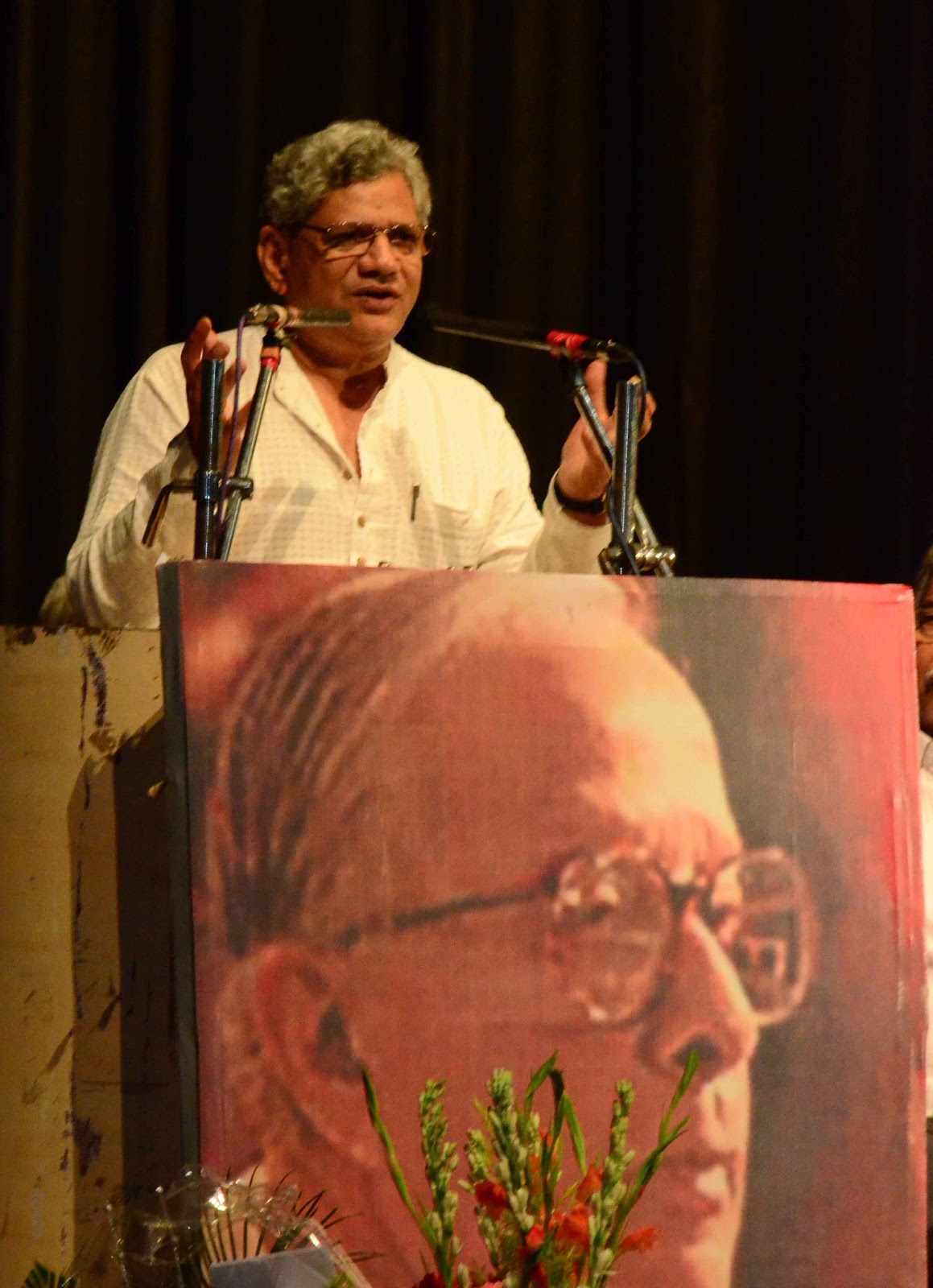
Lal Salam Comrade Jyoti Basu
By Sitaram
Yechury
July 8, 2013 marks the beginning of the birth
centenary of Comrade Jyoti Basu.
Even though all of us are aware of the
inviolable law of Nature that once life is born, it has to cease to exist one
day, this remains, universally, the most difficult inevitability to come to
terms with. Comrade Jyoti Basu’s absence,
particularly in today’s circumstances, is felt in every turn and twist. Yet, in
his absence, it is incumbent on our part to carry forward his legacy to advance
the objective for which he contributed all his life – the establishment of
socialism in India and eventually in the world.
The Legacy
Jyoti Basu’s seven decade long political life is
synchronous with the evolution of modern India.
For this very reason, he was always a source of inspiration and a `role model’ for the younger
generation. His legacy will continue to
be such a source. He, truly, was one of
the legends of modern India, not only of the Communist movement.
Having gone to England to return as a
Bar-at-Law, he was attracted to the Communist worldview, embraced the ideology
and returned to India in 1940 not to don the black robes but to plunge directly
into the freedom struggle by joining the Communist Party. Karl Marx had once said that when an idea
grips the minds of the masses, it becomes a material force. The desire for independence from British rule
had gripped the Indian masses when Jyoti Basu joined the Communist movement. He, however, was thinking ahead of what should
be the character and content of independent India. The political independence that would be
achieved needed to be converted into the
true economic independence of every Indian.
This meant the creation of a socialist society where exploitation of man
by man simply ceases to exist. It is
with this passion that remained undiluted till the end that he served the Indian people. During the course of his long and illustrious
life, he had to face many trials and tribulations but the commitment to the cause,
however, never wavered. He is a `role
model’ precisely for this reason: sheer power of his commitment to his
convictions.
Modern India, post independence, was evolving
through major struggles that led eventually to the integration of the feudal
princely States into the Indian Union.
The struggles led by the Communists brought to the fore the agenda of
land reforms and the abolition of feudal zamindari and other land tenure
systems. This was also the period when
the various linguistic nationalities in India who had united in the struggle
for freedom, were seeking their distinct identity. A process that finally led to the linguistic
reorganisation of the Indian States in 1956.
Jyoti Basu's political evolution converged with the evolution of modern India based
irrevocably on the premise that the recognition and celebration of India's
diversity can only be on the basis of its secular democratic foundations.
Jyoti Basu's firm commitment to our country's
secular democratic character and administrative structures remained a constant feature of his work and
activities. As communal forces represent
the very antithesis of this evolution of modern India, Jyoti Basu worked to isolate
and defeat the communal forces and strengthen the secular polity.
Simultaneously, his entire concentration was
on carrying forward the struggle to
convert India's political independence into economic independence for its
people – socialism. Within the Indian
Communist movement, however, a very intense ideological battle erupted on how
this was to be achieved. Steering clear
and battling against both the right and
left deviations, Jyoti Basu, alongwith his other comrades who eventually formed
the CPI(M), adopted the correct line of combining parliamentary and extra parliamentary
activity and struggles to achieve this objective. Jyoti Basu excelled in using parliamentary
democracy, its institutions and fora for both advancing this struggle and
simultaneously providing greater relief to the people.
The implementation of land reforms, the
deepening of democracy by developing the panchayati raj institutions and the
articulation of the need for better Centre-State relations to strengthen
India's federal character were some of his
important contributions to the process of the consolidation of modern
India. These apart, he was one of the first to constitute separate
ministries for environment and science and technology.
Apart from all these, the main facet of Jyoti
Basu's personality that attracted people towards him was his unassailable faith
in them. He would always urge the Party
and its cadre to go to the people and explain to them what we are doing and
take them into confidence. This faith in
the people was the strength of his credibility. They never questioned or even
doubted his integrity.
Jyoti Basu
as CM
Jyoti Basu voluntarily demitted office of the
Chief Ministership in West Bengal, in 2000, after a record tenure of 23 long
years setting new standards of political culture and morality in India. The
Polit Bureau of the CPI(M) had accepted his desire to step down since he was not satisfied with not being able
to discharge his administrative responsibilities as he was capable of doing earlier. In an atmosphere
where the lust for power has seldom seen people demitting office on such
considerations, this had come as a
breath of fresh air.
When Jyoti Basu took over as Chief Minister in
1977, the poverty ratio in West Bengal was nearly 52 per cent. In 1994, this
had come down to 26 per cent, a decline of 4.2 per cent per year. West Bengal
thus ranked the first, in poverty reduction, amongst all states in India.
Incidentally, the state ranking second is Kerala, with 3.7 per cent decline per
year. (source: India: Policies to Reduce
Poverty, World Bank, 2000). In
comparison, the rate for Maharashtra was 2.7 percent and in 1994 43.5 per cent
of its population lived in poverty.
Similarly, in terms of annual rates of growth of
the Gross state Domestic Product, West Bengal ranked No. 3, behind Gujarat and
Maharashtra with a 6.9 per cent growth per annum. Between 1991-92 and 1997-98
in per capita terms, it stood once again in third place following Gujarat and
Maharashtra with a 5.04 per annum increase. (source: Montek Singh Ahluwalia,
EPW, May 6, 2000).
Phenomenal advances have been made in the sphere
of agriculture. During this period, West
Bengal was transformed from being a chronic heavy food deficit state into one
with surplus. By the time Jyoti Basu demitted office, it became the highest
rice producing state in the country. West Bengal contributed nearly 20 per cent
of the increase in rice production in the entire country. The yield per hectare
has also shown substantial increase. More than 90 per cent of the state's
agricultural holdings belong to marginal and small farmers, as a result of the
success of Operation Barga. As a result of the successful
implementation of land reforms, noted economist Dr. Nilakant Rath then analysed
that the growth in per capita net domestic product of the agricultural
production between 1981-82 and 1994-95 went up by 22 per cent for the whole of
India but in West Bengal it went up by a whopping 70 per cent. In 1981-82, West
Bengal was amongst the lowest in the country with its per capita net
agricultural product being 18 per cent lower than the all India average. By
1994-95, it was above the all India average by about 10 per cent.
These phenomenal achievements in agriculture
have once again validated the position that land reforms are not an exercise
meant only to achieve distributive rights. While achieving this they also
unleashed rapid leaps in productivity which go a long way in reducing the
overall levels of poverty.
In terms of distributive justice, it merits
repetition that during Jyoti Basu's tenure as Chief Minister 13 lakh acres of
agricultural land were distributed amongst the landless. These were illegally
held by vested interests in the past. Even if a nominal value of Rs. one lakh
per hectare is considered, then the value of the land distributed would be to
the tune of Rs. 13 crore. Such has been
the dimension of asset redistribution in West Bengal in favour of the poor and
landless.
Thus by all counts, West Bengal during these 23
years under Jyoti Basu's stewardship had shown that it is possible to both
alleviate poverty and stimulate growth. But, one should not miss the wood for
the trees. All this was possible not because Jyoti Basu or the Left Front
government blindly embraced the economic policies of liberalisation. This was
possible because they made one fundamental departure from the economic
philosophy of liberalisation. And that is in the decisive role of State
intervention in achieving the objectives and priorities. Contrary to the
liberalisation pundits who advocate the withdrawal of the State from the economic
sphere and abdication by the State of its social responsibilities, the Left
Front government in West Bengal has played the role of the catalyst in
stimulating economic development and the role of the initiator in generating
sweeping agrarian reforms.
Sterling
Personal Qualities
During my association with Comrade Jyoti Basu in
our Party’s Central Committee for over two and a half decades, there are many
admirable qualities of his that need to be emulated. One, is his unassailable faith in the power
of reasoning based on the Marxist outlook.
No argument can ever be won with him on the basis of passion or
emotions.
The other facet of his personality is humaneness. During these years, I had on a few occasions
travelled abroad with him, when he held the office of the Chief Minister. Being the Chief Minister of West Bengal, he,
naturally, was entitled to a preferential treatment. But, he always preferred
to travel with other comrades and, till his last day in office, travelled only
in the economy class of Indian Airlines.
During such visits, he would,
forever, be concerned about the welfare of the other comrades always by taking
interest in their comforts and needs. I have, for instance, never seen him
loosing his patience even once!
Another enduring quality of his was a
self-imposed discipline with which he conducted his personal and political
life. He displayed the rearest of
soldier-like quality when his opinion in 1996 to accept the offer to become the
Prime Minister in the United Front government
was rejected by a majority of the Central Committee. Subsequently, the Party Congress at Kolkata
in 1998 had endorsed the Central Committee majority opinion. Notwithstanding his personal opinion, he,
till the end, upheld the majority view and worked steadfastly discharging his
responsibilities. Such steadfast loyalty
to the organisational principles of a Communist Party and its strict norms of
discipline is a quality that the younger generation needs to emulate.
Comrade Jyoti Basu had a unique sense of
humour. In September 1993, both of us
traveled to Cuba at the invitation of the Communist Party of Cuba for meetings
with Fidel Castro and the Party leadership.
We traveled via the Spanish capital, Madrid. On our return journey, we
had a full day waiting to catch the flight back to India. The Indian Ambassador to Spain asked if there
was anything in particular we would like to see in Madrid. Com. Jyoti Basu looked at me. I said that
since the original `Guernica’ of Picasso was in a museum in Madrid, it would be
nice to see that. This conversation was
on our way to Cuba. However, when we returned to Madrid, Com. Jyoti Basu was
not really feeling up to the mark to visit the museum. He suggested that I
should however go. Upon which the Indian Ambassador said that the museum was
being specially opened, on its scheduled off day, for Jyoti Basu. Hearing this, JB said, “How would they
recognize Jyoti Basu as they had never seen him before! Let Sitaram go, they
would not know the difference!”
Eventually I did go alone, the museum was opened and I saw the
`Guernica’!
Carry
Forward the Struggles
The consolidation of the modern Indian Republic
and elevating the much required bar of political morality can be achieved only
by pursuing this course as lived by
Jyoti Basu. The strengthening of the
secular democratic foundations and, importantly, to complete the unfinished
task of converting the political
independence of the country into the true economic emancipation of the people,
will define the contours of such a
consolidation. The widening hiatus
between `shining' and `suffering' India needs to be overcome.
This, in turn, requires, from all of us, the
strengthening of the spirit of selfless service to the people and the
country. Pledging his body to serve
medical science, Jyoti Basu on April 4, 2003, wrote : “As a Communist, I am pledged to serve humanity till my last
breath. I am happy that now I will
continue to serve even after my death.”
Jyoti Basu's indomitable fighting spirit that he
displayed all his life was there to be seen in death as well. Running his 96th year when he was
brought to the hospital with pneumonia, medical science and doctors, naturally,
saw not much hope. Jyoti Basu, as
always, was to surprise everybody. For
17 days, the fight continued. `Never say
give up' sums up the spirit of his life.
He is the last of the original nine member Polit
Bureau to leave us – the navaratnas that founded the CPI(M) and steered it through very troubling and exacting
times. The only homage that we can pay
to Comrade Jyoti Basu is by redoubling our resolve to carry forward the
struggle for human emancipation and liberty to its logical conclusion.
Lal Salam Comrade Jyoti Basu.
Labels:
2013,
BIRTH CENTENARY,
CPI(M),
SITARAM YECHURY
Location:
New Delhi, Delhi, India
Subscribe to:
Posts (Atom)


