Saturday, August 2, 2014

CPI(M) Organises Jyoti Basu Centenary Lecture


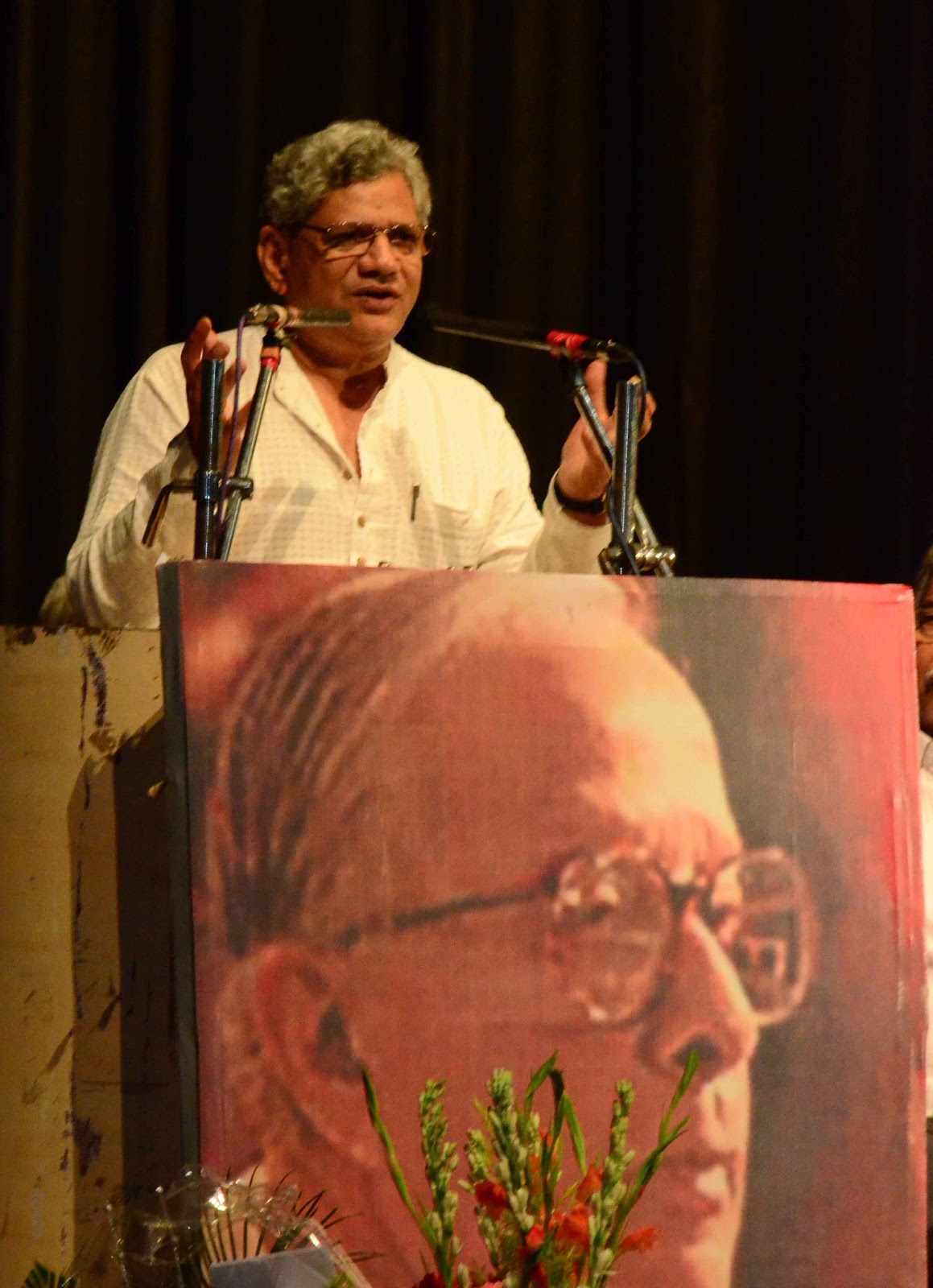
New Delhi, 30th July - THE Communist Party of India (Marxist) organised a lecture by noted economist Prof. Prabhat Patnaik on "Capitalism, Inequality and Globalisation" in New Delhi's Constitution Club on July 30, as part of the Jyoti Basu birth centenary celebrations.

In his short welcome address, CPI(M) general secretary Prakash Karat said Jyoti Basu symbolised the working class movement in India and its achievements. He said Basu, who was first elected to the Bengal Provincial Assembly in 1946 from the Railway Workers constituency, was an outstanding leader of the Communist movement in India.

Giving the Jyoti Basu centenary lecture, in the light of French economist Thomas Piketty's empirical book Capital in the Twenty-First Century which has attracted much international attention, Patnaik said "inequality has a tendency to increase under capitalism", and it is intimately linked to the process of globalisation.

Patnaik argues, though Piketty's hypothesis that inequality is set to rise in the coming year is agreeable, his theoretical basis -- the "neo-classical" paradigm -- within which his argument is set is a largely discredited one; and even within this paradigm his specific position is based on assumptions which are highly untenable.

The theoretical basis of Piketty is "wrong" having "dangerous political implications", he says.

The "neo-classical" paradigm, Patnaik said, blames trade union activities for persistent unemployment and advocates for "labour market flexibility". He says it is a pity that Piketty, despite his concern with wealth inequality, adopts this theory that only serves the agenda of corporate capital. He said the votaries of capitalism want to stamp out trade unions through "free hire and fire", which the BJP government in Rajasthan is at present trying to introduce.

Patnaik says mobility of capital in the present age of globalisation and large-scale privatisation have contributed to the weakening of trade unions. In support of his claim, he says while, in the USA, 33 percent of workforce in the public sector is unionised, it is only seven percent in the private sector.

He says the expansion of big capital across the world and, on the contrary, restriction of workers' movements to a particular country have further weakened the effectiveness of trade unions.

Patnaik says while world wealth and income inequalities are all set to rise sharply in the coming years as Piketty prognosticates, but, he argues, these are for reasons which are exact opposite of what the French economist believes.

He argues that the rise in income and wealth inequalities could not be attributed to, as Piketty has done in his Capital, the slowing down of world population growth leading to tightness in world labour markets, but for precisely the opposite reason – namely that there will be no tightness in world labour markets and no diminution in world labour reserves.

The programme was well attended. Veteran CPI leader A B Bardhan was among others who attended the lecture.


Tuesday, July 15, 2014

Jyoti Basu’s Birth Centenary - Call to Defend Democracy


KOLKATA, 8th July, 2014: The birth centenary of Jyoti Basu - one of the most revered Communist leaders, was celebrated in West Bengal on 8thJuly with a variety of programmes including blood donation camps, seminars and cultural programmes. A central public meeting was organized by Jyoti Basu Birth Centenary Committee in Nazrul Mancha in Kolkata, attended by thousands and addressed by Left leaders and intellectuals. Jyoti Basu's photos were garlanded outside CPI(M) offices and those of its various mass organisations in the city and the districts
The public meeting began with a short documentary on Jyoti Basu. The meeting, presided by veteran Forward Block leader and Chairman of the centenary committee Ashok Ghosh, witnessed the presence of people from all sections of life and leaders of various left organizations.
Biman Basu, addressing the meeting highlighted the sacrifice of Jyoti Basu in his early life when he travelled to all parts of Bengal to develop the trade union. Biman Basu said, Jyoti Basu left personal happiness and luxurious life to serve the toiling people. Biman Basu also deliberated how Jyoti Basu fought ceaselessly to defend democracy. His thoughts and ideas on the struggle for democracy are important now as West Bengal and the country are facing an attack on democracy.
Elucidating the contribution of Jyoti Basu to parliamentary democracy, CPI(M) Polit Bureau member Buddhadeb Bhattacharjee said, Jyoti Basu had brought the struggle of peasants and working classes to the centre of politics in West Bengal.  “He brought the issues of peasants and the workers to the fore in parliamentary democracy. Its origins lay in the workers movement which was followed by strikes and protest in factories. These protests turned into a phenomenon which engulfed the entire industrial sector and workers were successful is ascertaining their rights,” Bhattachrarjee said. When the Left Front assumed office,  unlike any other Chief Minister, he made it clear that the government will have to stand for the rights of farmers and agricultural workers. “The fight for land went ahead with giving pattas (land rights) to the farmers and then identifying the rights of share croppers,” Bhattacharjee said.
Bhattacharjee reflected on how Mr. Basu ensured that the State remained insulated from the communal strife in 1984 after the murder of Indira Gandhi and 1992 after demolition of Babri Masjid. “He was secular to the core of his heart. He knew that Communist movement and secularism has to go hand in hand,” Bhattacharjee said.
 “Jyoti Babu has an unwavering faith in democracy.. Despite himself being arrested a number of times for false charges when the Left Front government came to power in 1977 all political prisoners across political lines were freed. It was like a general amnesty,” he said.
Referring to present times Bhattacharjee said that it is clear that the politics in the country has taken a “right turn” with the alliance of corporates and Rashtriya Swayamsevak Sangha (RSS) ruling the nation but added that it is imperative for the Left forces to take lessons from Jyoti Basu's life and put up a fight.
Noted economist Prabhat Patnaik outlined the features of contemporary Indian politics and said, neo liberal policies have created a situation where growth of industrial production has reached almost  negative, rate of inflation has risen to almost ten per cent. Corporate elite have chosen Modi to come out of their own crisis. On the other hand, the rapid growth of unemployment has contributed to growth of lumpen proletariat. The dangerous repercussions of the process is already evident in West Bengal where the attack on women and criminal activities are on rise. This situation can give rise to fascism. Only the Left can counter the threat of fascism through struggle on alternative policy trajectories.
Patnaik said, unlike P Sundarya, Jyoti Basu was born in an elite family. But he identified himself with the working people of the country. He was one of the most popular Communist leaders after Castro brothers. The crisis in Bengal was the backdrop in which the Left movement in Bengal developed and leaders like Jyoti Basu emerged. The Left could play its role as real initiator of Bengal renaissance.
Veteran CPI(M) leader Hasim Abdul Halim, CPI leader Manjukumar Majumdar, RSP leader Khisti Goswami, intellectual Azizul Haque emphasized the need of Left unity in this hour of difficult struggle.  

Saturday, June 28, 2014

Tripura Remembers Jyoti Basu


By Haripada Das 
AGARTALA, 15th June: THE life and legacy of Comrade Jyoti Basu would always be the guiding light for the party so as to come out of the hard days that the party is facing today, and to carry forward the cause of the toiling masses that the party has been striving for. This was the essence of the points made by speakers at an overflowing hall meeting on the occasion of observance of Jyoti Basu’s birth centenary year at Rabindra Shatabsrshiki Bhavan, Agartala on June 15.
Biman Bose and Manik Sarkar, both Polit Bureau members of the CPI(M), addressed the hall meeting that was presided over by the party’s state secretary Bijan Dhar. At the outset, floral tribute and homage was paid at the image of the departed leader by the Polit Bureau members, Central Committee members, state secretariat members and state committee members present in the auditorium. Then followed the inaugural songs performed by two cultural units, namely Gandiv and Krishti Kala Kendra.
Biman Bose, the CPI(M)’s West Bengal state secretary and Polit Bureau member, presented a brief life sketch of Comrade Jyoti Basu. Biman Bose narrated the atmosphere in Jyoti Basu’s family which was very much friendly with the freedom fighters. This deeply motivated young Jyoti to take to a jihad against British imperialism. A young boy, whom his parents sent to London to build up a bright carrier, thus got involved in India’s freedom struggle and came in touch with communist leaders like R P Dutta in London. Basu ultimately came back to India to become a party wholetimer and dedicated his whole life to the cause of the workers, peasants and other toiling masses of the country. While a party wholetimer, he adopted the Bengali language which he was never taught in academic institutions, Biman Bose informed.
Bose also referred to Jyoti Basu’s role in the Tebhaga movement, in raising up women’s defence squads, his work among the railway workers, his guidance in the 1946 naval workers strike and all-India employees’ strike, his role in combating communal riots in 1946, his style of functioning underground when the party was banned in 1948, his leadership in the movement against the Bang-Bihar merger plan, his contribution in the relief work during the 1946 famine, his work as the party’s state secretary since 1953, his exemplary work as a legislator in West Bengal assembly which attracted people’s attention to the party’s work, and his leadership in the United Front governments in 1967 and 1969.
Today it is not the first time, Biman Bose said, that semi-fascist terror has been let loose against the party in West Bengal. It was unleashed in 1972 and was combated and finally defeated by the party. Jyoti Basu’s work in those days would remain the guiding force in our endeavours to resist the ongoing all-out attack perpetrated by the ruling Trinamool Congress on the communists in West Bengal today.
Referring to Comrade Jyoti Basu’s performance as a chief minister with the so far longest tenure, Biman Bose said Basu played a vanguard role in pressing for restructuring of the centre-state relations and organised several conclaves with the opposition chief ministers. This resulted in the setting up of Sarkaria commission which recommended several positive measures to protect the rights of the states against the centre’s whimsical attitude born out of political antagonism. Land reforms ensuring distribution of excess land to the poor farmers and establishment of barga rights in West Bengal were unequivocally appreciated by one and all, and became a model for the country. Basu won nationwide respect for his valiant stand during the anti-Sikh riot in Delhi in 1984 and Babri demolition in 1992. His flexible attitude but ideological firmness in leading a coalition government for 23 long years is a great lesson for all of us, Biman Bose said.
Explaining the new situation in the country, Manik Sarkar said a pro-Hindutva party has now come to power in Delhi with the so far biggest share of seats in its life with a minority share of votes. In fact the BJP subtly and craftily exploited the fallouts of the Congress led UPA government’s misrule, which unleashed all-out attacks on the lives and livelihood of the common people of our country over the last ten years, coupled with huge scams involving trillions of rupees of the government exchequer. The BJP also had the blessings of the corporate lobby which lavishly poured out money for its poll campaign, Manik Sarkar said.
However, Sarkar said, there is no reason to take this change as permanent or think that everything has been lost. The fact is that 69 percent of the voters did not support the BJP. We have to reach out to those sections of the people; we have to bring about a change in their thinking and consciousness. There is no room for getting frustrated. Comrade Jyoti Basu’s life and deeds teach us to go to the masses again and again. We must also approach the vast masses who do not support us. All the questions raised by them must be answered politely, with facts and reason. They must be imparted class consciousness and drawn to the mass and class organisations. The BJP has nothing good to render to the people. Rather it is committed to compensating the big corporate houses which helped it come to power. Our national unity and communal harmony are now under severe threat from the RSS, the hardcore Hindutva force that has always been controlling the BJP from behind the curtain. The CPI(M) alone cannot combat this danger. We must rally all the like minded secular forces with us. If we successfully do it, that would be the true homage to late Comrade Jyoti Basu, Manik Sarkar asserted.

As for Tripura, Manik Sarkar said, Jyoti Basu always paid special attention to our state, particularly because of the extraordinary ethnic bonding of tribal and non-tribal masses in the state; this is something uncommon in other states of the country. He would cite this feature of the state while addressing the people in other states.
Expressing deep respect for late Comrade Jyoti Basu in his opening speech, Bijan Dhar said Jyoti Basu was a beloved leader of the people of Tripura. He started visiting Tripura since 1951 and came here many times till 2005. He came here in our victory as well as in our hard days during 1988-93. He helped the state unit of our party with his valuable suggestions and advices on many occasions. If we look back upon the history of the Indian communist movement, we will see the communist party moving forward while facing one crisis after another. Referring to the poor performance of the party in Lok Sabha elections, emergence of the BJP as the ruling party with an absolute majority in the parliament, and the semi-fascist attacks let loose on the communists in West Bengal, a strong base of the party, Dhar said we are now undergoing yet another crisis, but that is no reason to be frustrated. The teachings of Comrade Jyoti Basu would show us the path to overcome this crisis, he concluded.
The hall meeting ended with the rendition of Internationale in chorus.


Peoples Democracy, 22nd June, 2014

Wednesday, November 27, 2013

CITU Observes Jyoti Basu Birth Centenary

By R Karumalaiyan
People's Democracy, November 24, 2013

HELD at Kannur in Kerala, the last national conference of the Centre of Indian Trade Unions (CITU) had called upon all its affiliates to observe Comrade Jyoti Basu Birth Centenary in a fitting manner throughout the year, starting from July 8, 2013. Accordingly, the Tamilnadu state unit of the CITU has chalked out a series of programmes to take the Comrade Basu’s message to the mass of workers.

On July 8, a state level seminar was organised in Chennai to flag off the celebrations. Here, eminent parliamentarian Era Sezhian, Justice K Chandru, senior advocate R Vaigai, former West Bengal chief secretary B S Raghavan and CPI(M) Central Committee member T K Rangarajan, MP, spoke on different facets of Comrade Jyoti Basu’s life and work.  CITU state president A Soundararajan, MLA, chaired the seminar.

It was followed by a series of district level seminars and intensive political ideological classes for leading functionaries at various levels of the organisation.

The port city of Tuticorin is the place where Comrade Basu attended the national conference of Water Transport Workers Federation on October 31, 1984, the fateful day when Smt Indira Gandhi was shot dead by her own bodyguards. Here the centenary celebrations comprised multifarious activities. The CITU formed a Comrade Jyoti Basu birth centenary celebration committee, involving several class and mass organisations. former VOC College principal Prof Maragathasundaram and CITU district secretary V Balasubramanian were elected its chairman and secretary respectively. 

The activities here included drawing, elocution and essay writing competitions for school and college students in the district, with students from 82 schools and four colleges participating therein. On November 8, there was a marathon race in which around 1,100 students participated.  Dr (Prof) Seethalakshmi, principal of the APCV Mahalakshmi College, inaugurated the race.

On November 10, CITU national president A K Padmanabhan, state CITU general secretary G Sukumaran and secretary R Russell addressed a well attended seminar in Tuticorin. The centenary committee also brought out a souvenir documenting the life of Comrade Jyoti Basu and carrying articles from CITU leaders.

Similar programmes were organised in Tirunelveli, Virudhunagar and Madurai on November 11 and 12, addressed by A K Padmanabhan and R Karumalayan, assistant general secretary of state CITU. At Tirunelveli noted Tamil literary critic and SahityaAcademy award winner K A Sivasankaran, aged 90, participated with all enthusiasm, recalling Comrade Basu’s finest qualities as a role model for public life in independent India, along with E M S Namboodiripad. He added, “I would be failing in my duty if I didn’t recall Comrade Basu’s contributions to Bengal art and literature which has one of the finest traditions in Indian diaspora.” 

In all these events Cultural troupes from the AIIEA and transport union along with local groups enthralled the audiences with their creative performance. A K Padmanabhan took part in all these events, urging the workers from this part of our country to carry forward the great legacy of Comrade Basu and his unflinching ideological commitment to the working class. He said contemporaryIndia has no parallel to him.

In the context of opposition to the neo-liberal policies, the CITU president said the Left Front government of West Bengal, under Comrade Basu, all along supported the national strikes called by central trade unions since 1991.

CPI(M) district secretaries K S Arjunan (Tuticorin), A Sekar (Virudhunagar), K G Baskaran (Thirunelveli) and B Vikraman (Madurai Urban) and CITU leaders M Asokan, S Balasubramaniyan and Kovilpatti town’s former chairperson Ms R Mallika also participated in these programmes.

In the first phase of the CITU state committee’s intensive ideological political training programme for its leading functionaries during the Basu birth centenary year, a three-day school was organised for the CITU state committee members and federation leaders at Virudhunagar on November 9-11. A K Padmanabhan took a class on ‘The History of Working Class Movement in India with Specific Reference to the Post-Independence Period.’ T K Rangarajan spoke on ‘Contemporary Capitalism’ while noted economist Dr Venkatesh Aathreya explained the political economy of Indian planning. Madukkur Ramalingam, editor incharge of TheekathirMadurai edition spoke on communalism. CITU state general secretary G Sukumaran inaugurated the session and state president A Soundararajan concluded with his remarks on how to face the current challenges.

Earlier, a two-day camp was organised in Dindigul on September 4 and 5 exclusively for women cadres working in trade unions. Some state level federations also conducted separate educational programmes as a part of Comrade Basu Centenary. TASMAC employees federation and auto workers federation took the lead. Thiruvarur district unit of the CITU organised a programme in September, in which A Soundararajan and state CITU’s assistant general secretary Thiruchelvan participated. 


Convention at COIMBATORE Remembers Comrade Jyoti Basu

By M Girija

People's Democracy, November 24, 2013

COMMEMORATING the birth centenary of Comrade Jyoti Basu, a great communist leader, the Coimbatore district committee of the CPI(M) organised a convention on November 18, with the party’s general secretary, Prakash Karat, delivering the main address. While celebrating the birth centenary of Comrade Jyoti Basu, Karat said, we should draw lessons from the life and work of this great revolutionary. India has seen many communist leaders who made great contributions and sacrifices. But Comrade Jyoti Basu was one of the few leaders who stand tall among them. He spent 70 years in the communist movement. He joined the Communist Party in 1940 and passed into history in 2010. In these seven decades of communist life, this great leader made very significant and pioneering contributions. He returned from London as a barrister but began to work as a trade union functionary among the railway workers in Bengal, becoming the secretary of the railway workers’ union of Bengal. Though he was the chief minister of West Bengal for about three decades, he had his association with the trade union movement intact, and remained a leader of the CITU till the end.

JYOTI BASU IN LEGISLATURE
The second major contribution of Comrade Basu was in legislative sphere. He got elected to the Bengal Assembly in 1946, before independence, from the railway workers’ constituency. From 1946 to 2010, except for a period of five years following the rigged elections in West Bengal in 1972, he remained a member of the West Bengal assembly, and showed how a communist should function in a legislature. While he was a leader of the opposition, he led many struggles and echoed the voices of struggling workers and others inside the assembly. In all the major struggles, Comrade Basu made it a point to personally lead them, both within and outside the legislature. Once he stayed inside the premises of the assembly for three days lest the police should arrest him, in case he came out, for leading the teachers’ struggle.

When he became the chief minister of West Bengal in 1977, we saw how he carried forward the land reforms there. After being a part of continuous struggles when he was the deputy chief minister in United Front government earlier, he told the peasants and Kisan Sabha members to go and occupy the lands the landlords were holding illegally. Through this combination of outside struggles and legislative action, Jyoti Basu showed the way as to how communists could utilise such avenues. Between 1967 and 1969, when he was the home minister of West Bengal, he told the police would not interfere with any strike conducted by workers, nor it would be used to stop the peasants from occupying the surplus lands in landlords’ illegal possession. His lasting legacy as the chief minister of Left Front government is of the land reforms that were implemented in Bengal, when 11 lakh acres of surplus land were taken over and distributed among the landless farmers and 1.5 crore tenants got security of tenure by registration.

Karat further said: “History will also remember him as a leader who was most consistent in the defence of secularism. Everyone knows that after the assassination of Smt Indira Gandhi in 1984, Sikhs were killed in thousands in the whole of North India. But Comrade Basu did not allow a single attack on the Sikh community in Calcutta or West Bengal. Similarly, in the 1990s, when communal forces began the movement for Ram temple in Ayodhya and communal riots broke out all over the country after Advani’s rathyatra, Jyoti Basu said not a single person would be allowed to be attacked in West Bengal, and that he was ready to invite the army if necessary.” Comrade Basu was not only a communist leader; he was a symbol of the Left, democratic and secular forces in our country. That is why today, when we are observing his birth centenary, we must pledge to continue to uphold the values, principles, politics and ideologies which he represented, Karat added.  

Speaking on the current politics, Karat said today in our country we have a government which is following policies that are causing great sufferings and distress to the people of the country. In this context, he touched upon issues like the excruciating and unabated price rise, especially in case of food items and other essentials; favours being meted out to the big capitalists and foreign multinationals; agrarian crisis and the farmers’ sufferings, rising unemployment etc, with education, housing, healthcare etc all going beyond the reach of the common man. Unless we are able to reverse these harmful neo-liberal and anti-people policies being pursued by the UPA government, there can be no real relief and no real development and progress for the people of our country. “That is why the CPI(M) and other Left parties have put forth alternative policies,” Karat added. 

In the context of the Lok Sabha elections which are nearing, Karat also attacked the Bharatiya Janata Party which claims to be an alternative to the UPA and the Congress, while Narendra Modi is going around the country posing as if he is already the prime minister elect of the country. But, Karat said, the BJP is not a whit different from the Congress in terms of policies, and that we have seen in practice, e.g. in the BJP’s support to the UPA government on the issue of banking laws, privatisation of the pension funds etc.

Karat further said if the BJP today, under the leadership of Narendra Modi, is claiming to be better than the Congress, it is better in only one way --- Narendra Modi is a more ardent and vigorous supporter of the big business houses of our country. They talk about the Gujarat model of development for the country. But what does the Gujarat model mean?  Under Modi, all the big business houses – from Ambanis to the Tatas, Essars, Adanis –have been given huge concessions, free land, free electricity, tax exemptions and other concessions so that they could make super profits. This is the model of development which Narendra Modi wants to implement in the whole country. Another aspect of the Gujarat model, which Modi and BJP do not talk about, is how they organised attacks on and carried out the most heinous pogrom against the Muslim minorities in Gujarat in 2002, under the auspices of the Gujarat government. 

The CPI(M) leader also pointed out that even though the Congress and the BJP both say they would lead the government after the Lok Sabha elections, they have, taken together, not been able to get 50 percent of the votes in the last two Lok Sabha elections. As for the non-Congress, non-BJP parties, they command substantial support among the people and are successfully running many state governments. So we are confident that in the coming days the people will reject the UPA for its wrong policies and massive corruption and also the BJP for its equally corrupt practices in the states it is ruling and its communal politics. What is required is people’s mobilisation and struggle to demand alternative policies that are different from those of the Congress and the BJP. In this context, Karat also referred to the recent Delhi convention of 14 non-Congress secular parties and its significance.

Referring again to Comrade Jyoti Basu as an architect of land reforms in West Bengal, Karat said more and more people are losing their land today. According to the latest census figures of 2011, in the last ten years 35 percent of peasants have become agricultural workers, which means 35 percent more people have lost their land. That is why we say we have to still implement the land reforms and distribute lakhs of hectares of surplus land among the landless people and give housesites to lakhs of families. These are some of the alternative policies required in the country today.

Talking of the contours of a policy alternative, Karat included in it a minimum wage of Rs 10,000 per month for unskilled workers, more government spending on education and health, and taxing the rich for adequate resource mobilisation, among other things. It is through struggles on these issues that a political alternative to the Congress and the BJP would emerge, he added.

Concluding, Prakash Karat expressed confidence that the efforts of the CPI(M) and other Left parties would find a reflection in the coming Lok Sabha elections, and the non-Congress, non-BJP forces would get substantial electoral support.

CPI(M)’s Tamilnadu state secretary G Ramakrishnan and its Central Committee member A Soundararajan, MLA, also addressed the convention. Both of them recalled the memories of Comrade Jyoti Basu.  

The convention was presided over by U K Vellingiri and inaugurated by V Ramamurthi, secretary of the CPI(M)’s Coimbatore district committee. S Krishnamurthi welcomed the participants and Kesavamani proposed the vote of thanks.  


Earlier, a sum of Rs 10,08,500 was handed over to Prakash Karat by the Coimbatore district committee as the second instalment of the election fund donated by the people.
Thursday, September 19, 2013

Amartya Sen on Jyoti Basu centenary panel advisory board

KOLKATA: Nobel laureate Amartya Sen will be a member of the advisory board of the Jyoti Basu Birth Centenary Celebration Committee, said Rabin Deb, CPI(M) State Committee member here on Monday.

He was speaking at a discussion to finalise the names of the members of the committee.

Other eminent members of the committee include the former Chief Minister, Buddhadeb Bhattacharjee; the former Lok Sabha Speaker, Somnath Chatterjee; film director Mrinal Sen; poet Sankha Ghosh; and former Indian captain Sourav Ganguly. State CPI(M) Secretary Biman Bose will be its general secretary.

Pointing out that Jyoti Basu had created an impression at the personal level too, with the various people he interacted and worked with, Mr. Bose said the aim was to highlight “milestones” of the political career of the Marxist leader.

Mr. Chatterjee said: “I believe the committee will be able to bring into focus Basu’s work for the public and his faith in the people.”

Samaresh Banerjee, retired judge of the Calcutta High Court, recalling the administrative capabilities of Basu, said “He was not only a politician, but a real statesman.”


Tuesday, August 13, 2013

I voted against Jyoti Basu's candidature as PM: Manik Sarkar


TNN Jul 31, 2013, 03.45AM IST

AGARTALA: After 17 years, Tripura chief minister and CPM politburo member Manik Sarkar on Tuesday said he had voted against the move of making Jyoti Basu the Prime Minister in 1996.

Sarkar said this during a condolence meeting of CPM leader Samar Mukherjee who died Kolkata on July 18.

"The CPM central committee had decided not to take part in the central government with Jyoti Basu as prime minister through voting in 1996 and I had also voted against participation in the central government," said Sarkar.

"I voted against the party's participation in the government but did not disclose it to others because several veterans, including former Tripura CM Dasarath Debbarma, was also a CPM central committee member," he added.

It shows that he was not dared to disclose the decision because his political mentor and former Tripura CM Nripen Chakraborty was expelled from the party in 1995 for criticizing the CPM leadership, including Basu.

In 1996, Basu might have become the PM of a United Front government but the CPM didn't allow him to accept the high office that paved the way for HD Deve Gowda of Janata Dal to become PM for 10 months. 

I voted against Jyoti Basu's candidature as PM: Manik Sarkar

Friday, August 2, 2013

Tussauds-like wax tribute in Asansol


In Asansol’s Mahishila Colony, believe it or not, you can meet Jyoti Basu, Maradona, Mithun Chakraborty and Uttam Kumar in one room.

Of course, not alive and kicking, but as life-like wax models, all made by Sushanta Roy.

A better reference point to what Roy has done would be the wax statues in Madame Tussauds in London, where many a Bollywood star has found place.

On July 8, Sushanta celebrated Jyoti Basu’s birth centenary. He made offerings of food and flowers, as if to a god — which perhaps would have displeased the communist leader.

Roy, 50, has been making the wax sculptures for decades. He had been an admirer of Basu and had the privilege — if it can be termed so — to take his measurements at Indira Bhavan for the statue.

The Basu statue had been at Indira Bhavan from 2003 to 2011 — a gift on the then chief minister’s 89th birthday. But after the leader’s death, Roy was requested to take it back to Asansol. The statue, he said, was “melting for lack of care”.

Now in an air-conditioned room, Jyoti Basu has found a place beside Manna De, who plays a harmonium — the singer is in wax, not the harmonium, by the way.

Roy said he had been visiting Indira Bhavan since 2003 and would “congratulate Jyotibabu always on his birthdays”.

“The last time too I had gone to attend his birthday celebration organised by Pather Panchali,” Roy said.

Pather Panchali, an NGO run by Ramola Chakraborty, widow of former transport minister Subhash Chakraborty, had decided to set up a museum like the one of Madam Tussauds in London and had asked Roy, who trained in sculpture in Calcutta, to make 100 wax idols of well-known personalities — for the proposed museum in Salt Lake.

The proposal came to naught after Subhash Chakraborty’s death.

Roy, a former employee of the Indian Museum, completed 18 wax idols. “among them are Basu, Vidyasagar, Rabindranath Tagore, Swami Vivekananda, Kazi Nazrul, Kishore Kumar, Manna De, Uttam Kumar, Sourav Ganguly, Amitabh Bachchan, Maradona, Kapil Dev, M. Karunanidhi and Sachin Tendulkar,” he said.

He took care to include props to signify what each celebrity did. So, Sachin is seen holding aloft a bat and Sailen Manna, though old and bald, kicking a football. Mithun has a mike in his hand.

Amitabh Bachchan’s wax model was the first one that Roy made. It was commissioned by a fan club.

For some of the stars and politicians, Roy got a chance to take measurements. Madame Tussauds, too, takes measurements of celebrities which become much-photographed events leading to the opening of the statue at the museum.

For those whom Roy could not meet, “I had to make to with pictures,” he said.

Asked about the quantity of wax he need for each statue, Roy gave an example: “It took around 50kg of wax to make Subhash Chakraborty.”

Roy said the idea of making life-size wax models was prompted by a popular Nazrul song Momer putul (doll of wax).

Roy said he first makes the stuffing. “For that several kilos of cotton and paper are required. The wax is used after that.”

Also, all the statues are foldable to allow transporting convenience.

A finished sculpture could cost anywhere between Rs 50,000 and Rs 1.5 lakh. Some of the statues he made were sold to clubs of Bollywood fans.

Roy himself takes care of the statues, cleaning them every day in the air-conditioned room where they have to be kept. He runs a school near his house where he teaches children to sculpt wax idols.

After Basu’s death, the leader’s aide Joy Krishna Ghosh had called up Roy and requested him to take the statue back.

Roy got the statue back to his Asansol home in September 2011.

“I discussed the matter with Bimanbabu (Left Front chairman Biman Bose) and called up Sushanta Roy who had gifted the idol to our beloved Jyotibabu. I requested him to take it back for its better preservation,” Ghosh told Metro over phone.

On Basu’s birth anniversary on July 8, around 20 to 25 friends and neighbours of Roy gathered on the ground floor of his house to celebrate.

A two-pound cake was cut and lunch was served to the statue. “Basu’s favourites — pabda and tengra machher jhaal, flavoured rice, muger dal and payesh were served,” Roy said. There was also raj bhog, mihidana and sitabhog, all traditional sweets of Burdwan, to round up the feast.


What will happen to this collection after Roy? The wax sculptor thinks his grandchildren “Arnab and Sanjib, two toddlers who take great interest when I work”, would keep the collection in shape. 

SEE MORE:
Tussauds-like wax tribute in Asansol

Jyoti Basu Birth Centenary Observances Begin in Maharashtra

By Mahendra Singh

MUMBAI: ON July 8, 2013, the Mumbai committees of the Communist Party of India (Marxist) and the Centre of Indian Trade Unions (CITU) flagged off the Jyoti Basu birth centenary celebrations with a joint public commemorative meeting in Venmali Hall in Dadar (West). The hall was fully packed on the occasion. A photo of late Comrade Jyoti Basu adorned the dais, along with a photo of late Comrade Ahilyatai Rangnekar, a beloved party leader, whose birthday also falls on July 8. Mahendra Singh, the CPI (M)’s Mumbai committee secretary presided. Seated on the dais were CPI (M) Central Committee member and state secretary Dr Ashok Dhawale, Central Committee member K L Bajaj, and all-India vice president of the CITU, CPI(M) state committee member and the CITU’s all-India working committee member Sayeed Ahmed, CPI(M) state secretariat member Professor Krishna Theckedath, state committee members Dr S K Rege and Shailendra Kamble, and CITU Mumbai secretary Dr Vivek Monterio. Dr Ashok Dhawale and K L Bajaj garlanded the photo of Jyoti Basu and Ahilyatai Rangnekar respectively. While Dr Dhawale, K L Bajaj, Sayeed Ahmed and Vivek Monterio highlighted Comrade Jyoti Basu’s outstanding contribution, they also dwelt on the purpose of the meeting. Shailendra Kamble conducted the proceedings.

The CPI (M) state committee’s organ, Jeevan Marg (Marathi weekly), had published a special issue to commemorate the Jyoti Birth centenary. K L Bajaj released the new issue at the meeting.

In his introductory remarks, Sayeed Ahmed praised the invaluable contribution of Jyoti Basu to the Indian working class movement and to the work done by the Left Front government of West Bengal in the interest of the toiling masses and common people including the workers, peasants and agricultural workers, under his chief ministerial tenure. K L Bajaj dwelt on the important role played by Jyoti Basu in founding and building the CITU. He also highlighted the stellar contribution of Jyoti Basu in the Indian working class and communist movements. Addressing the audience, Dr Vivek Monterio pointed to the 50 years long membership of Jyoti Basu of the West Bengal legislative assembly; he said Comrade Basu’s ideal style of functioning in it as a communist is a guide for communists for all the time to come. Dr Ashoke Dhawale, in his detailed speech, threw light on various aspects of the outstanding personality of Comrade Jyoti Basu and his invaluable contribution in the Indian communist movement and in building of the CPI(M). He referred to the police lathi blows faced by Jyoti Basu as a school student while participating in a public meeting addressed by Netaji Subhash Chandra; his participation in the activities of India League and London Majlis while studying in London; his stellar performance as a legislator, opposition leader, deputy chief minister, home minister and chief minister; the pro-people activities of the first Left led government of West Bengal under his stewardship; his immense contribution in strengthening the Left politics in India and raising the issue of restructuring of centre-state relations; his unique party loyalty and adherence to party discipline; his firm belief in Marxism-Leninism; his daily visit to the party’s state committee office even when he was discharging onerous responsibilities as the chief minister; his unshakeable faith in the toiling masses; and his exhortation to the party members to increasingly strengthen contacts with the masses. In his speech Mahendra Singh urged upon the audience to plan various programmes during the year long observance to take the message of Comrade Jyoti Basu to the wider masses and to take pledge to advance the cause for which Jyoti Basu worked for almost seven decades.

All the speakers also paid tributes to Comrade Ahilyatai Rangnekar.

The meeting ended with slogans like “Jyoti Basu Lal Salaam,” “Comrade Jyoti Basu Amar Rahe” and “Long Live Marxism-Leninism!”

Friday, July 12, 2013

Social media users pledges allegiance to Jyoti Basu's politics

IANS; Updated: Tuesday, July 9, 2013, 12:55 [IST]

Kolkata, July 9: Hundreds of social media loyalists of Jyoti Basu renewed their allegiance to the late Marxist patriarch's ideologies Monday - the launch of the former West Bengal chief minister's centenary celebrations.

Legions of loyalists paid tribute to their celebrated "Comrade" through comments and poems on the social networking site Facebook.

Pledging support to Basu's philosophy, many dubbed the "leader of masses" as an inspiration.

A post said: "Aj amader priyo jononeta Comrade Jyoti Basu er Jonmo Sotoborsho....Tumi aj o acho amader majhe Onuprerona hoye...Tomar dekhano poth e amra chilam, achi & thakbo ei sopoth nilam...(Today is our beloved people's leader's birth centenary...you live among us an inspiration..we are and always will be on the path that you have shown us..)".

Some vowed to undo the "deviation from the ideologies of Comrade".

"Comrade Jyoti Basu'r jonmosotobarshiki upolokkhe 1ti bishoye protiggabodho hoya khub joruri,,seta holo adorso-goto jetuku bicchuti hoyeche, setak sudre naoya..setai hobe COMRADE sothik sroddha janano (On the centenary celebrations of Comrade Jyoti Basu we have to pledge our return to the ideologies of Basu.. from which we have deviated..that will be the true way to to pay respect to him)".

The Communist Party of India-Marxist has lined up year-long programmes throughout the state, highlighting his life and philosophy to mark the centenary celebrations.

Born July 8, 1914, Basu joined the Communist Party of India in 1940 and began his work in the railway trade union movement. In 1946, he was elected to the Bengal legislative assembly from the Railway constituency.

He played a key role in the development of the communist party in India and was the secretary of the CPI's provincial committee from 1954 to 1960. He became a member of its central committee of in 1951. When the CPI-M was formed, he became one of the founder politburo and central committee members. 

Calls for Defending Democracy

Jyoti Basu’s Centenary Observance

Kolkata, 8th July:  THE birth centenary of Comrade Jyoti Basu began on July 8 with a call to defend the ideology he represented and tirelessly worked for.

The CPI(M) state committee organised a public meeting in Mahajati Sadan in Kolkata which was addressed by Prakash Karat, general secretary of the CPI(M) Biman Basu, state secretary and Buddhadeb Bhattacharjee, Polit Bureau member of the CPI(M). Leaders of the Left Front and other Left parties were present in the meeting. Thousands of people gathered to attend and had to listen to speakers standing outside on the road.

Speakers recalled the contributions of Jyoti Basu in the Left movement and in Indian politics.

The question of democracy, for which Jyoti Basu fought a long battle, came to the forefront.  Prakash Karat said, ‘’West Bengal blazed a new trail in democratic decentralisation under the leadership of Basu through panchayati raj which was institutionalised much before the 73rd and 74th amendments of the Constitution. The spirit of democracy and the great experiment of democratic decentralisation which developed and flourished under Basu is now under severe and vicious attack.  We are in the midst of a panchayat election that was sought to be scuttled and sabotaged by the powers that today are ruling West Bengal. The people, the Left Front and the democratic forces in the state will defend the legacy of Basu, who made the greatest contribution to the deepening of democracy in the country. They will fight back all these anti-democratic onslaughts that have been launched over the past two years in the state.”

“If you look back at the career of Basu, there is no other leader, irrespective of political party who has shown such a capacity, vision and determination to show that India remains and will be a democratic, federal and secular country,” Karat pointed out.

Describing Basu as a leader who knew how to work in parliamentary arena, Karat said he showed how a Communist Party should integrate work in the parliamentary forum with the movement outside.

“The birth centenary of Basu should not be just an occasion for us to commemorate and pay tribute to his glorious life,” he said. It would be more meaningful to utilise the year-long observance of the leader’s birth centenary to spread the ideas he stood for, Karat suggested.

 “Whether it is a question of defence of democracy, defence of secularism or defence of working people, all contributing to a social transformation that will make India a more equitable and just society, this is what Basu stood for,” Karat said.

Buddhadeb Bhattacharjee recalled the early life of Jyoti Basu and said that after returning from abroad, he decided that the path of India’s liberation lied in liberation of the working class. Basu joined in the working class movement and worked among the dock and railway workers. Throughout his life, the ideology of working class was his ideological commitment.

Bhattacharjee said, Jyoti Basu brought the question of workers and peasants to the centrestage even within the legislature. His speeches within state assembly in support of peasants’ and workers’ struggles were historic.

Bhattacharjee recalled how steadfastly Basu defended secularism and thwarted any attempts by communal forces when the Left Front government was in office. He said, ‘’We are faced with a new danger again. On the one hand, it is Congress with neoliberal policies and on the other hand, BJP with neoliberal policies plus Narendra Modi”.  He added, the doors of this state have been opened to the BJP and Modi. This is frightening.

Bhattacharjee pointed out that the panchayats, which empowered the poor are under serious threat. He called upon the people and the Left activists to work hard to keep the panchayats in the hands of the poor.

Biman Basu, presiding over the meeting, outlined the struggling life of Jyoti Basu and how he built working class organisations despite heavy odds. He also reflected upon Jyoti Basu’s contribution to the cause of federalism in the country. It was Jyoti Basu who raised the demand of more powers to the states and brought the agenda to the centrestage of Indian politics.

CPI(M)  also announced a year-long programme on the occasion of the birth centenary of Jyoti Basu. ''A wider programme cannot be chalked out initially as panchayat election is round the corner and also considering the fact that people will be busy in campaigns and polls,'' Biman Basu said. He said the Party would project the life and activities of Jyoti Basu through seminars, posters, documentaries and an effort for political education.

On July 8, red flags were hoisted in all parts of the state. In some districts, processions with Jyoti Basu’s portrait were organised. In many areas, blood donation camps were organised.

Respects were showered on Jyoti Basu in state assembly too. Leaders of different political parties paid rich tributes to Basu, particularly recalling his democratic way of functioning both as the opposition leader and chief minister and how he used to treat criticisms respectfully.

But the longest serving chief minister's centenary celebrations were surprisingly missing from the Writers' Buildings, where the present government has been observing birth anniversaries of luminaries throughout the year.

People's Democracy,

July 14, 2013